

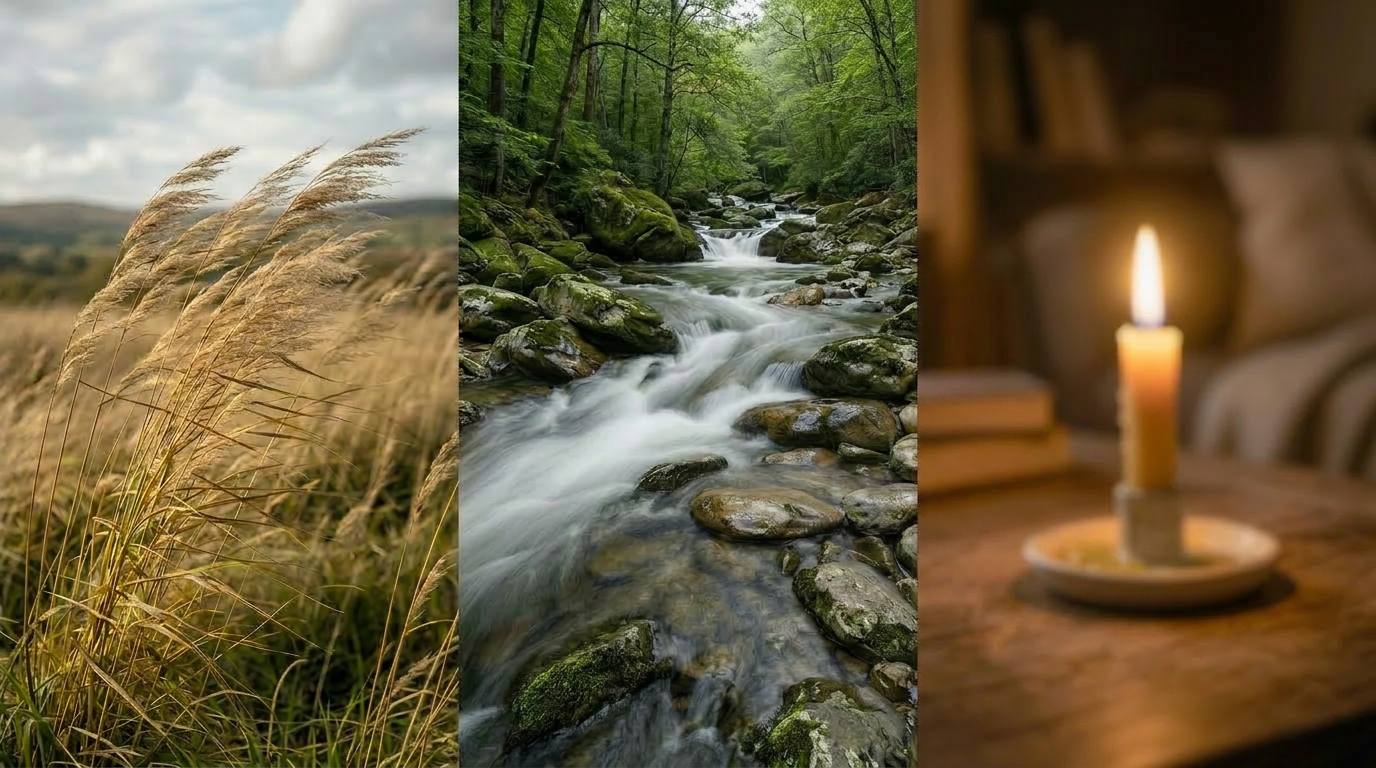
There is an old idea, older than philosophy, that the elements are not merely substances but teachers. Air, water, fire — before they were chemistry they were ways of understanding what it means to be alive in a world that moves, shifts, and burns. The pre-Socratic thinkers of ancient Greece built entire cosmologies on them. The Indian tantric tradition mapped them as tattvas — fundamental categories of manifest reality, not just physical phenomena but ontological principles, ways reality presents itself to experience.
What follows is an attempt to recover something of that depth, not as metaphysics but as practice — and to do it in a distinctly Western key, using phenomenology as the organizing principle. The question isn’t what the elements are but what they do to you when you inhabit them fully. And the first move is deceptively simple: stop thinking of the elements as nouns.
Think of them as verbs.
The Verb Reframe
Air doesn’t just exist. Wind blows. Water doesn’t just sit. It flows. Fire, the closest cousin to pure action, glows.
The shift from noun to verb is more than grammatical. A noun names a substance you might contemplate from a distance. A verb names a movement you can participate in, a stance you can inhabit, an orientation you can be in the mode of. This is the phenomenological move: from observation to participation, from description to lived experience.
Three verbs, then. Three stances. Three distinct ways of meeting the world with your whole self.
Blow
Stand outside on a day when the wind is moving. Not a breeze — a real movement of air, the kind that has weather behind it. Now stop trying to do anything with it. Stop bracing against it. Stop analyzing its direction or temperature. Simply… open.
What you may discover is that the wind doesn’t stop at your skin. It presses against, reads every surface. It finds every exposure. If you are successful in opening fully, you will begin to find inner permeation occurring — the admission of the subtle atmosphere the wind is carrying. The moving atmosphere has the capacity to treat you not only as an object, a form in the movement, but as a membrane — something it can move through and over, something with surfaces worth touching.
This is the contemplative stance of blow: radical receptivity to an encompassing movement you didn’t initiate and cannot direct. The ancient Hebrew word ruach meant both wind and spirit — and the Gospel of John captures the stance precisely: you hear the wind blow, but you don’t know where it comes from or where it’s going. You are not the navigator. You are not even the destination. You are the membrane through which something vast and ungoverned passes.
The surrender here is total, and yet something unexpected happens in that surrender: when the form stance is maintained, the boundary of the self becomes intensely alive. You might expect that handing yourself over completely would dissolve your felt sense of where you end and the world begins. The opposite occurs. The membrane lights up. Every surface becomes sensate, awake, ingesting in some sense — fed by what passes through.
This is blow as spiritual stance: rootedness, but with maximum surrender, maximum aliveness. The self emptied of resistance becomes paradoxically most present — most itself as a receiving form.
Practices that incorporate this stance include open awareness meditation, the Hesychast tradition of inner stillness, yoga nidra, and the receiving phase of Tibetan tonglen — the willingness to be breathed through by whatever the moment carries, without flinching.
Flow
Now imagine yourself in a river. Not swimming against the current, not anchoring yourself to a rock — but releasing your stance entirely and letting the water take you.
Flow is a different surrender than blow, and the distinction matters. In blow, you hold your form while the atmosphere moves onto and ultimately through you. The membrane remains; the field passes across it. In flow, you release the anchor itself. You become part of the movement rather than a surface it crosses. The self doesn’t disappear — but it stops insisting on its position.
Flow has directionality, which blow deliberately withholds. A current is going somewhere, even if you can’t see the destination. To enter flow is to trust that somewhere — to align yourself with a movement already underway rather than trying to generate your own. The philosopher Alfred North Whitehead described reality itself as a creative advance — a cascade of arising moments, each inheriting from the past and moving irreversibly toward the future. To flow is to align consciously with that advance, to stop treating the present moment as something to hold and instead participate in its inherent motion.
Spiritually, flow means saying yes to the flux of experience — all of it, not just the welcome parts. Whatever arises in the stream of your life, the stance is: I move with this.
Current is perhaps the truest name for what flow offers: life as current, experience as alignment. Practices that live here include authentic movement, Sufi turning, vipassana body scanning, lectio divina followed wherever it leads, and spontaneous qigong — any practice where you release volitional control and follow what’s actually moving.
Glow
The third stance is the most interior, and in some ways the most demanding.
Think of a candle — not a flame that flares and consumes, but a steady glow. Dense at the center, radiating outward, offering its light and warmth to whatever surrounds it without depleting itself in the offering. This is the tattva model for fire at its most refined: a concentrated interior that expresses itself radially into the field.
Glow as contemplative stance means finding that center in yourself — identifying it, inhabiting it deeply, igniting it — and then allowing what is genuinely interior to move outward. This is not performance. It is not projection. It is the natural expression of something that has been sufficiently concentrated and activated.
The sacred heart of Christian mysticism is one image of this — a heart that radiates. The Tibetan tummo practice of inner fire is another, more literal invocation. The Indian tradition speaks of the anahata, the heart center, as a flame that burns without fuel. And there are those rare individuals — teachers, elders, saints — in whose presence you feel something before they speak. Aurobindo was said to have manifested what one witness described as a solid, cool block of peace that could be felt in the room. Not warmth necessarily, not fire in the conventional sense — but a density of presence that moved outward and registered in the field around it.
Glow doesn’t require that you be a saint. It begins with the simpler discipline of returning to your own center, again and again, until you can feel it — and then learning to let it speak. Pranayama practices, metta meditation once it reaches the radiation phase, chanting practices rooted in the lower abdomen, blessing — these are glow practices. What they share is the cultivation of a charged interior that moves outward as presence.
Three Stances, One Ground
Blow, flow, glow — three distinct phenomenological relationships between self and world. In blow, the field is primary; you receive. In flow, you and field are continuous; neither is primary. In glow, you are the source; you emanate.
Together they cover the full range of self-world relationship without privileging any one as the final truth. A complete contemplative life might move among all three — knowing when to open as membrane, when to release the anchor and join the current, when to inhabit the center and let it radiate.
For those drawn to philosophical depth, the process philosophy of Alfred North Whitehead offers unexpected resonance with this triadic model — and not by coincidence. Whitehead argued that reality at its most fundamental level is not composed of static things but of dynamic events, each arising through prehension — an act of receptive ingestion of the surrounding field — which maps precisely onto the stance of blow. These events flow together in what he called the creative advance, an irreversible movement of occasions from past through present into future that is the ontological ground of what we experience as current, as flow. Each occasion possesses an interior — a subjective aim, an inherent orientation toward its own unique completion — which is the philosophical correlate of the charged center that glow cultivates and expresses. And the telos of the whole process, for Whitehead, is the production of intensity — aesthetic richness, depth of felt experience, contrast held in harmony. Blow, flow, and glow, understood in this light, are not merely useful practice orientations. They are ways of consciously participating in what reality is already doing at every level.
Behind all three, the Indian tradition would say, is Akasha — space itself, the prior ground from which the elements arise and into which they return. It is the silence within which blow, flow, and glow become audible. Whether Akasha points toward a fourth practice-stance, or whether it names the fruit of the other three matured, is a question worth sitting with.
For now, three verbs are enough. Step outside. Feel what’s moving. Ask yourself: am I being blown through? Am I in the current? Is there something in me ready to glow?
The elements have been waiting for you to stop studying them and start inhabiting them.
This post was developed with the collaboration of AI.
Leave a Reply