

γνῶθι σεαυτόν
Greek, translated:
Gnōthi seauton -“Know thyself”
Ancient Greek aphorism inscribed
at the Delphian temple, attribution uncertain
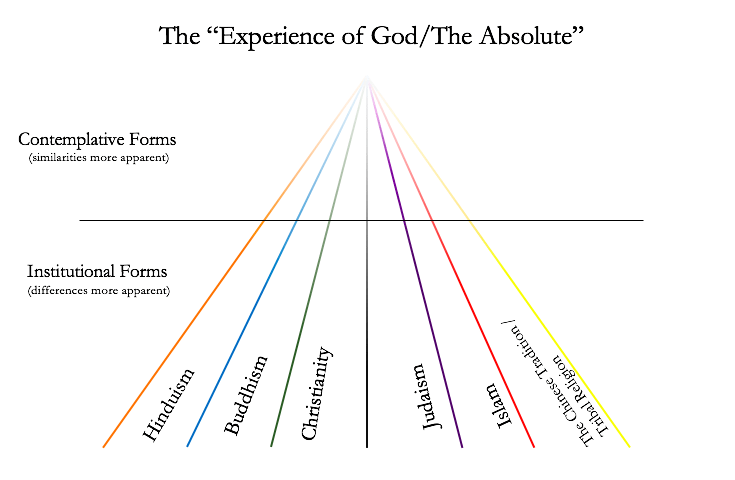
In a simple and common metaphor, consider a Himalayan peak at the beginning of a climbing season. Several expeditions gather at camps around the base prior to embarking on their climbs. These expeditions may travel overland from many different nations to arrive at their base camps. Many different nationalities may be represented at one base camp; crucial to the set-up of this story, there are other base camps on other approaches and aspects of the mountain, out of sight and unknown to the others. As each expedition makes its way up the mountain on one of the few main approaches, the view increasingly opens to a more and more inclusive perspective which becomes steadily more uniform amongst the different parties until at the peak, the view is the same for different parties in all directions. Above a certain rarefied altitude, not only is it possible to see other routes leading to the same destination, but parties could be in sight of one another, though there had been no visibility or possible contact before. Whether a northeast ridge, a western face, or a southern route, all ascents converge at the summit. And even if the parties do not meet at the summit simultaneously, they can each report and give testimony that accord in the specific details as to what exists on the summit. These testimonies serve as proof to those below of a singular summit on a singular mountain.
This representation, while mundane and imperfect, as all metaphors are, is generally a faithful and apt analogy of the perennial philosophy in its relation to the religions that serve for its incubation. The base camps and the various overland approaches to them are humanity in its multiplicity. The main approaches and routes up the mountain are akin to the major religions. The unified view that sees the singularity in multiplicity, the oneness in diversity, like the summiteer on the mountain summit, is the perennial philosophy.

The perennial philosophy asserts that in each major religious tradition of the world shines an esoteric, living core drawing its continued life and sustenance from the unmanifested Source that serves as its Transcendental referent. This living thread, this mystic heart of the religion, while still showing distinct characteristics indicative of its religion or creed of origin, shares a similar warp and woof with other perennialist threads from sister religions, one that the mystic (or mystically-inclined) can readily recognize as being from the same singular Source. Islam has its Sufi tradition; Christianity its Desert Fathers and gnostic schools, Hinduism its Vedanta and Tantra, Buddhism its Zen and satoris. The teachings of the inspired in these traditions sound, to the initiated ear, like the utterances of a single broad family, with various dialects of course, but recognizably drawing from the same Fount of Wisdom[i]. In the perennialist view, major avatars of the traditions, if they exist, are those individuals who have discovered and established their stances in the unmanifested Source of all being and speak or teach from it. The perennial philosophy is not restricted to religions alone; well-developed and mature philosophies, like Neo-Platonism, and literary movements, like the Transcendentalism of the 1800s which brought forth writers like Emerson and Thoreau, can begin to touch into the realms of the unified vision. That these works still speak to us today testifies to their timelessness, rooted in universal and everlasting truths and virtues.
While the living content of the perennial philosophy itself is as old as the human race, it did not begin to surface in Western civilization’s consciousness until the Renaissance. Drawing from roots in third century Neo-Platonism, with Plotinus’s idea of “the One”, philosophers and thinkers of the 1400s and 1500s began to posit a synthesis of ideas from Christianity and certain tenets of Western philosophy. Marsilio Ficino (1433–1499) synthesized elements of Hermeticism with Greek and Jewish-Christian thought. Giovanni Pico della Mirandola (1463–94)[ii] suggested that truth could be found in many, rather than just two, traditions. His Oration on the Dignity of Man remains an astounding and far-sighted assertion for his day, especially considering the young age (23) at which he burst forth with this. Agostino Steuco (1497–1548) was the first to use the term philosophia perennis (Latin) and proposed that one and the same divine truth was to be found in the religious and philosophical traditions of different periods and places, all of which could be considered as different manifestations of the same teaching.
It has only been comparatively recently, since the early 1900s, that the perennial philosophy was formally conceptualized and identified as a synthesis of multiple wisdom traditions. This relatively youthful genesis is likely due to a steadily-decreasing size of the world, the increasing rapidity of communication world-wide, and an increasingly global exposure to and apprehension of the religions and thought systems of other cultures. In the early 20th century, these trends were only beginning to exert their influence. Writers like William James in The Varieties of Religious Experience (1902), Aldous Huxley in the namesake The Perennial Philosophy (1946), and Huston Smith in The World’s Religions (1958) were instrumental in shaping and identifying the conceptual framework for the perennial philosophy for Western audiences. Psychoanalysts like Carl Jung delved into psychological archetypes, or common patterns and themes that underlay the human experience, noting that they existed in cultures across the world. The great mythologist Joseph Campbell‘s works, while rarely addressing the perennial philosophy as such, are saturated throughout with the themes, archetypes, and symbols of collective humanity’s psyche, drawing parallels and mapping similarities across cultures and through the centuries. His idea and development of the concept of the monomyth is based on the assertion that the human psyche is one, and the bewildering number of stories fraught with heavy symbolism and significance can be related to the grand schematic of a unified myth – a universal story. In other words, a perennial philosophy, brought to life through ritual and metaphor.
But what of the specific content of this philosophy? What common factors exist that can be communicated to humanity in its multiplicity? Aldous Huxley, contributing an essay to Vedanta for the Western World (Editor: Isherwood) in 1945, summarized these common factors as a “Minimum Working Hypothesis” for the perennial philosophy:
- That there is a Godhead, Ground, Brahman, Clear Light of the Void, which is the unmanifested principle of all manifestations.
- That the Ground is at once transcendent and immanent.
- That it is possible for human beings to love, know and, from virtually, to become actually identical with the divine Ground.
- That to achieve this unitive knowledge of the Godhead is the final end and purpose of human existence.
- That there is a Law or Dharma which must be obeyed, a Tao or Way which must be followed, if men are to achieve their final end.
- That the more there is of self, the less there is of the Godhead; and that the Tao is therefore a way of humility and love, the Dharma a living Law of mortification and self-transcending awareness.
The Perennial Philosophy is expressed most succinctly in the Sanskrit formula, tat tvam asi (‘That art thou’); the Atman, or immanent eternal Self, is one with Brahman, the Absolute Principle of all existence; and the last end of every human being, is to discover the fact for himself, to find out who he really is.
Aldous Huxley, The Perennial Philosophy
This, then, is the general conceptual framework in understanding the Perennial Philosophy as a whole.
Further Resources
- Oration on the Dignity of Man, Pico della Mirandola
- The Perennial Philosophy, Aldous Huxley
- The World’s Religions, Huston Smith
- The Varieties of Religious Experience, William James
- The Book: On the Taboo Against Knowing Who You Are, Alan Watts
- The Joseph Campbell Foundation
[i] There are several works published that compare the sayings of major religious figures side-by-side for those inclined to pursue such study. This type of comparative religion study, focusing on the essences, is very valuable in overcoming the intellectual skepticism and inherited biases that one may hold by virtue of a life-long stance in a more materialist frame of reference (scientific or atheistic) or an established religious tradition. One of my formative college term papers was written comparing the Nag Hammadi Gospel of Thomas logions with sayings from Hinduism, Buddhism, and other eastern religions and philosophies. This study, while highly recommended for aspirants, is beyond the scope of this site.
[ii] I confess Pico della Mirandola is a personal favorite of mine. His master work, Oration on the Dignity of Man, may be found elsewhere on this site.
 Via Perennis
