

Richard Moss
A MODEL FOR SELF-INQUIRY AND RETURNING TO OUR ESSENCE
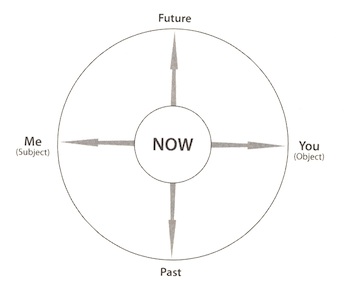
In the Mandala of Being, the large circle represents the totality of who we are, with our complex and often perplexing ability to be grateful and resentful, trusting and fearful, peaceful and violent, loving and hateful, from one moment to the next. The center of the Mandala is the Now-moment, where, through the quality of our attention, we constantly create ourselves anew. In any mandala, whether the center is shown as a point or a lotus flower or a Buddha resting in profound self-possession and repose, the true center is always the Now, where all the opposing forces in our lives have a common origin and therefore can be integrated. In the present, through the power of our awareness, we exercise direct conscious relationship to our thinking and feelings instead of being victims of them. In our own now-ness, we touch the Source from which our essence radiates. This is presence.
The four positions on the circumference of the circle — the Past, Future, Subject (Me), and Object (You) — are the four directions our minds are drawn in when leaving the Now. These four are the foundations of our psychological consciousness. The moment we lose sufficient connection with the Now, we collapse into our own peculiar psychological realms in which everything we perceive and think (about ourselves, others, past, and future) is distorted in accordance with the particular adaptation of our survival personalities and enculturation. It is a personal psychological dream world.The Mandala of Being provides a model for self-inquiry into the specific emotional dynamics that govern our lives at each of the four outer positions. At the same time, it provides a practice of Self-remembering, reorienting us toward the Now, where we can live as our authentic and spontaneous selves. […]
By becoming acquainted with the four positions of the Mandala —Past, Future, Me, You — and understanding their crucial relationship to the central Now position, we can each learn to recognize the unique ways we abandon the present and lose contact with the immediacy of our beings. We can come to understand how we sustain false identities through the beliefs we hold about the past and the future and through the recurrent stories we tell ourselves (and believe) about who we, and others, are. Inevitably we recognize that much of what we constantly tell ourselves through our thinking is false. We can learn to appreciate what each of these stories or beliefs does to our states of being and recognize the actual sensations they create in us.
Richard Moss, The Mandala of Being: Discovering the Power of Awareness
Introduction to the Mandala of Being:
Using the mandala in helping a client work through a problem:
 Via Perennis