
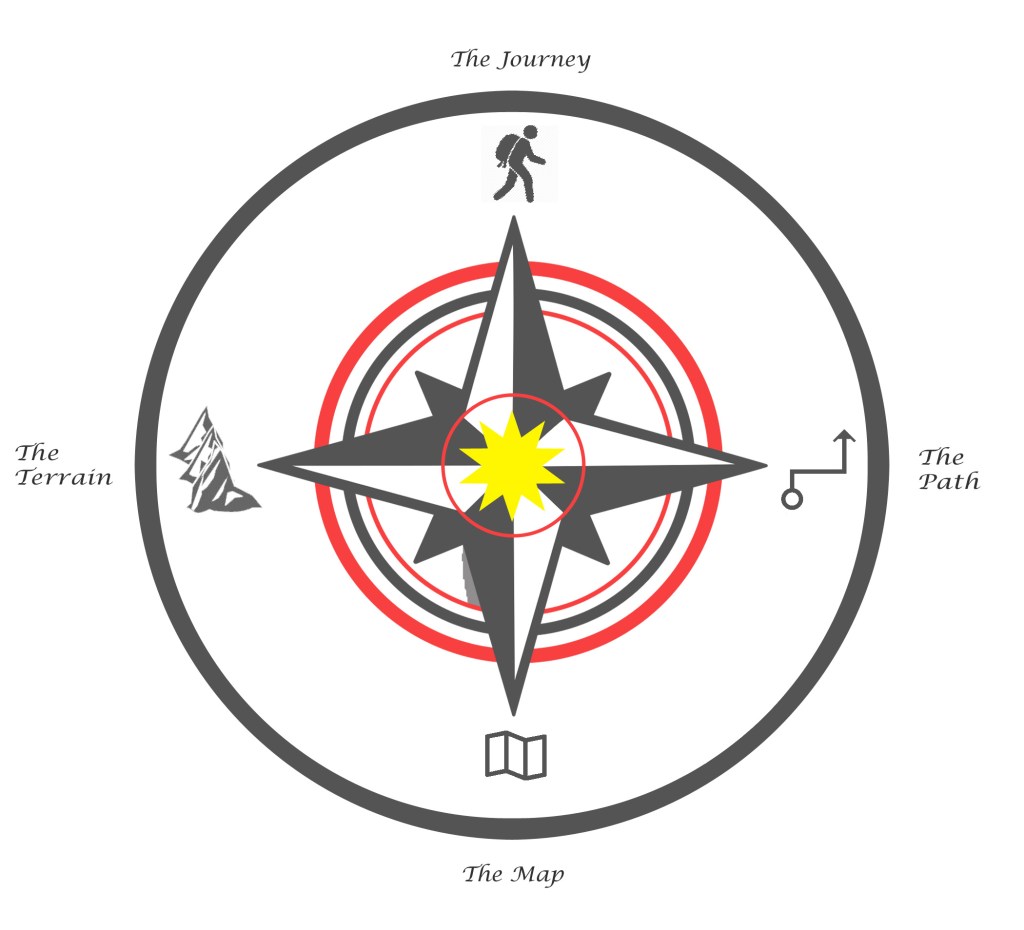
As a template of understanding, another way Via Perennis can be considered is in terms of the constituent parts of the mythic/spiritual quest through time. In this formulation, we are not focusing on the different aspects of a human life (body, heart, mind, spirit), but on its unfolding through time for an individual who is moving along the Way enroute to the destination, which is spiritual Realization. Realization , the final aim of the journey, is symbolized in the mandala above as the blazing sun in the center of the image.
The Terrain
Here, we begin with the Terrain on the left side of the mandala, which is the unnamable totality, both subjective and objective, in which we find ourselves immersed. This is the Tao – the Way. And where there is a Way, a journey or quest is implied, with all of the supporting elements that go along with that.
The Way is vast and inscrutable, as this chapter from the Tao te Ching reminds us:
The tao that can be described is not the eternal Tao.
Tao te Ching, Chapter 1
The name that can be spoken is not the eternal Name.
The nameless is the boundary of Heaven and Earth.
The named is the mother of creation.
Freed from desire, you can see the hidden mystery.
By having desire, you can only see what is visibly real.
Yet mystery and reality emerge from the same source.
This source is called darkness. Darkness born from darkness.
The beginning of all understanding.
The tao that can be described.
The raw terrain, without any interpretation or intermediate screening, is a bewildering and overwhelming place. Help will be needed to orient and navigate through it. The following elements provide those functions.
The Map
At the bottom cardinal point, we have a representation of a map. The map signifies beginning to get one’s bearings in the terrain and performing the cross-translation necessary within the human mind so that a general understanding of one’s place in the terrain is gathered. There are limits to how far this translation can proceed, and exceeding those limits can lead one astray, for reality ultimately cannot be reduced to language and concept. We’re familiar with the phrase “The map is not the territory.” This phrase was coined by Albert Korzybski, founder of the field of general semantics, in the book Science and Sanity. The meaning of this phrase is that the cognitive apprehension and abstract understanding of reality is not identical with reality itself; it is a mere representation, or model, of that reality. There is a supporting corollary derived from statistician George Box, who opined, “All models are wrong, but some models are useful.” Nowhere is it more important to keep these dictums in mind than in the consideration of a spiritual exploration and quest. The terrain of the totality of the inner and outer worlds is by nature ultimately uncapturable in language or concepts; it transcends both. And we must always keep in mind that the map we construct of that terrain is in the final analysis “wrong” and cannot be other than “wrong,” in that it cannot accurately portray that which defies conceptual delineation. However, the map can be more or less useful, depending on how well it illustrates selected aspects of that reality and promotes movement towards the final destination, which is spiritual Realization. The map is indispensable, for without it, one cannot select a direction, let alone launch a journey.
The map, then, is analogous to the intellectual framework adopted as an explanatory model of reality, the philosophy or set of metaphysical beliefs one subscribes to. In the age before our current ultra-rational age, the map would have been the distinct cultural myths and religions that bound societies together and gave individuals a sense of meaning and their place in the cosmic order. It was bestowed upon the individual, who accepted it as unquestionable and infallible. Indeed, the “individual” as a concept didn’t really exist in those times – the notion that a person could exercise autonomous discrimination and judgment on what was bestowed could not even have been conceived of.
Today, cultural myths and religions still exist and can provide many of the same functions (understanding that my use of the word “myth” here is not intended as pejorative in any sense). As noted in the discussion on the perennial philosophy, the globe is a smaller place in the last 100 to 150 years, and we now have access to many different myths and philosophies to make sense of the world and the spiritual quest, access that previous generations did not have. With increasing rationality and the increasingly prominent exercise of a critical faculty in our culture, evolution is pushing us towards accepting the responsibility for compiling our own maps in a way that makes sense in our personal journeys.
Initially, cartographies are necessarily adopted from those who mapped the terrain before. These cartographies become more and more detailed and accurate, insofar as they can extend, with continued refinement and additional understanding. Think of, for example, the halting and incomplete mappings of the New World’s coast in the 1500s compared to the satellite photography-derived maps of today. So, too, it is with spiritual cartographies. Spiritual, religious, and philosophical understandings refine and become more detailed and illustrative with continued application and effort by the parent culture (or inspired individuals) to “update the maps.” The transcendental truths they express may be eternal and unchanging, but that doesn’t mean that the expression of that truth cannot be improved upon. However, the key point I want to make here is that we are all initially the beneficiaries of and dependent on those map-makers’ efforts who went before us – the spiritual giants, the avatars and Lights who revolutionized our worldviews, the interpretive structures that grew around their insights and teachings, and those that independently drew maps to the best of their understanding based on the reporting of the spiritual Masters. The generations of laborious effort that went into religious and spiritual map-making reaching back into antiquity gives us a distinct leg-up in getting our bearings relatively quickly. And thus it must be in the beginning, and in some cases it remains so throughout the journey.
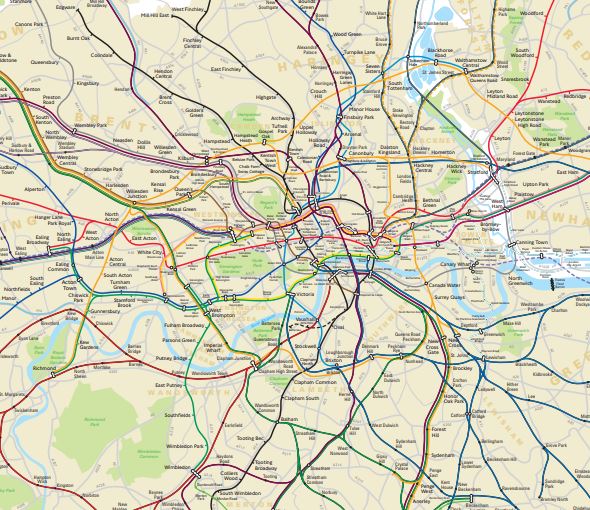
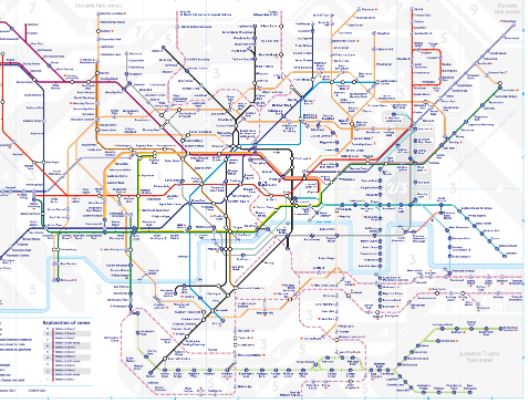
It is possible, however, to acquire and fuse all of the skills necessary to create and bequeath an entirely new map at a certain stage of development. These insights come when one achieves the destination and from a higher vantage point, can see and consequently lay out an orientation that is new, and even more useful to human beings at their current stage of development. As an analogy on a prosaic level, I am thinking here of how the London Tube in recent decades has come up with a public map design for their subway system that is at once elegant and informative. While it clearly does not “accurately” match the layout of the system on land, it orders the system layout and preserves the essential critical information for riders to make necessary determinations to get to where they want to go with a minimum of extraneous and unhelpful information:
Thus, too, the possibility exists for entirely new spiritual maps to be developed that serve their functions even better than existing maps, and the individual on the spiritual quest may ultimately become one of those revolutionary map-makers. Sometimes, these new maps may be called “streams of teaching.” Maps that become deeply-rooted and are widely-available and used graduate from a simple stream of teaching into the founding doctrines of religions that persist for lengthy periods. But a map need not attain this lofty status to be useful. For those of us still on the journey, it is always wise to keep an eye out for better maps, meaning maps that more effectively serve their informing function and better assist in the movement towards the goal. This does not necessarily suggest that old maps are discarded, rather all maps continue to contribute to the general understanding of one’s place in the spiritual cosmology and are used to buttress, support, and further illuminate the ever-evolving mental map for the traveler from multiple angles, until such time that maps are no longer needed for the individual. In the final analysis, it is not the map as object, the symbolic transmission of it via writings or recordings that is “the map”, but rather the mental map built in one’s mind as a result of consulting object maps. This is where comparative religion and comparative mythology come in; they can serve a very great clarifying function for the seeker. Joseph Campbell was an exemplar and master of synthesizing spiritual maps across many cultures, finding similarities, and making sense of them for his audiences:
The Path
Sometimes, the map comes pre-bundled with a path. This happens with regularity in established religious traditions, and thus it is easy to overlook the inconvenient fact that if a direction is not provided or consciously chosen, the journey remains moribund, trapped in a merely theoretical status. The path is comprised of the structural elements providing a defined means to the end. In Catholic Christianity, for example, the path for believers consists of the seven sacraments – baptism, confirmation, partaking of the Eucharist, confession (or reconciliation), anointing of the sick, matrimony, and Holy Orders (ordination). Often, elements of the path like these are enacted by rites or rituals, thereby surrounding and adorning it with ceremonial ornamentation. This can be helpful in amplifying and reinforcing the faith, especially within a like-minded community, but it is not always compatible with all temperaments, particularly for those of a strong intellectual bent following more of a jnana-yoga approach, or those of a contemplative orientation. For those engaged in an effort to build their own non-traditional spiritual sadhana, one must clearly distinguish between the maps, which can be relatively passively acquired and assimilated at the outset and may already have implicit paths bound up within them, and the path or direction itself, which requires active discrimination and the selection of one’s course through the terrain towards the destination. Selection of the best path for oneself must take into account what one understands of the destination or objective of the practice and the congruence of the goal and the path, but it also requires considerable self-awareness of one’s native tendencies and inclinations if fruitful results are expected for the effort put into the practice. Does one conceive of God as personal or impersonal? Transcendent, immanent, or both? Does one feel the call to participate in joyful, even ecstatic community, or the pull into solitary and quiet reflection and contemplation? Does one have an affinity to Eastern methods and understandings, classic Western ones, or shamanistic/aboriginal mythologies? Does one feel a natural interior assent and concordance with the map of any of these religions or philosophies? These are choices and clues that the seeker must pay close attention to, listening interiorly, and following the call discerned in response.
Developing and/or settling on the path is perhaps the most difficult step of the quest, for it requires a rigorous winnowing of several, sometimes many, options available to find the one path most optimal for you. Joseph Campbell posits interior guidance on this question with his notion of “following your bliss;” this can be an important part of it, and it will ensure fuel for the journey in terms of active interest and engagement for the long term, perhaps an entire lifetime. But personally, I don’t believe it’s quite that simple, that the idea of bliss-following should comprise the totality of one’s seeking and path selection. If what Carl Jung proposes of human development is true, one of the tasks of a human life is to develop one’s inferior functions in the last half of life in the quest for achieving wholeness. I suspect this is true. Very few people relish the opportunity to naturally undertake what is difficult for or foreign to them, yet, like vegetables for kids, it may be necessary to have seasoning for one’s path that the seeker knows would be good and salutary for her to incorporate, even if that piece of the practice is not a blissful or natural one for the traveler. If one has elected to pursue a type of integral practice, then by definition, parts native and not so native to one will be in the final mix of the elements of path selection. A more in-depth discussion on the virtues and rationales of developing an integral path may be found elsewhere on this Website.
The Journey
At last, we come to the journey itself, represented at the uppermost cardinal point of the mandala. This is where all of the previous preparation begins to come into fruition, to manifest. The cliché goes, “The journey of a thousand miles begins with a single step;” true, but more importantly, one recognizes that the journey is larger than a single step – it requires thousands, hundreds of thousands steps, each one drawing on the same commitment through time. The seeker’s intent and goal needs to ever reside in front of him. Yet there is some Divine magic involved here as well; it is not only the seeker’s effort involved in the journey. One becomes aware in certain moments, if one is on an appropriate path, that there is a life flow that assists in carrying one forward. That flow has an intent and purpose of its own, a teleological character working behind the scenes in concert with the seeker’s efforts. The seeker may not even be aware of this supernatural assistance until after the fact; when I look at the bread crumbs I followed through the decades of my search, I am struck by how seamlessly they tied together and gradually led me to my current understanding. I didn’t plan that ahead of time; indeed, I didn’t know exactly what I was seeking at the outset, let alone how to plan or direct the trail going forward. The Design came from somewhere else, Somewhere beyond me.
In a certain context, the individual spiritual journey can then become the Hero’s Journey. Joseph Campbell developed this idea in a multifaceted way in his book The Hero with a Thousand Faces in 1949. In this video excerpt from The Power of Myth PBS series in 1987, Campbell lays out the broad contours of what the hero’s journey is and how it may be invoked.
One of Campbell’s most important developed ideas from The Hero with a Thousand Faces was the idea of the monomyth, a general template that many of the world’s mythic and religious figures followed in enacting their journeys. Campbell showed in astute and far-reaching detail how across cultures and eras, heroes of all types, even those who might not conventionally be considered heroes, tended to follow the same general template for the journey. That template is illustrated below.
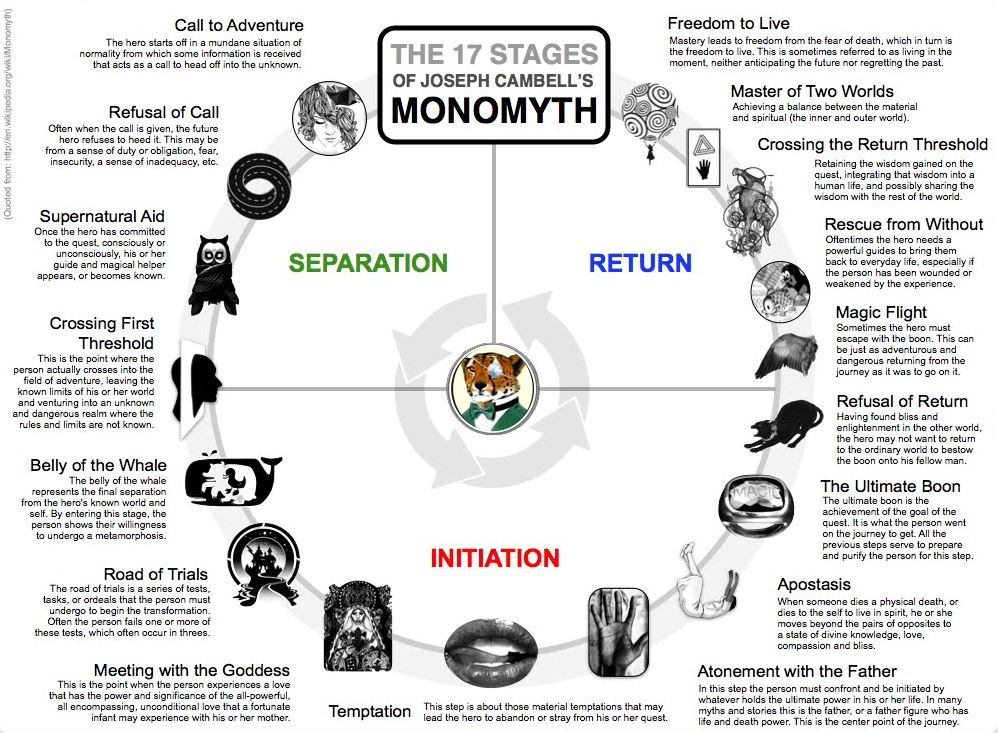
The Hero is then identical in mythology with one who accepts the first step of the journey, the “Call to Adventure” and steps outside the confines of the local environment he has always and only known. This is synonymous with the beginning of the spiritual journey. The story of Siddhartha Gautama, the future Buddha, venturing beyond his protective palace walls and encountering the Four Sights – old age, illness and pain, death, and a spiritual aspirant – is a classic illustration of embarkation on the Hero’s Journey, the stepping across a threshold into unknown adventures.
All of the foregoing may seem to be…laborious to say the least. And in the early stages, it can indeed be laborious. It is no small task to persevere through identifying the map to use, orienting oneself according to the map, charting a path to a destination intuited but not known for certain, and setting forth on the journey one has plotted for himself. And the knowledge that the journey may not be a few steps, but perhaps tens of thousands, even hundreds of thousands of steps once embarked upon, with no firm assurance of attaining the goal, might soon be disheartening for the one relying on personal will to make the journey. But a strange kind of alchemy can begin to show itself during the journey, and the traveler begins to dissolve into the journey itself. The personal effort begins to fall away, and the Journey is taken up by the Nameless Motive Power underlying All as the wayfarer becomes more and more emptied of the personal self. This brings us full circle as we return to the inherent wisdom of the Tao that we spoke of in opening this discussion.
The recurring image of the Tao is that of a watercourse-like Way. The Tao, at once the ultimate formless sink and the myriad of movements spawned ultimately by that sink, takes its course naturally in moving towards its destination, like a river following the path of least resistance and relying on its fluidity and weightiness in flowing towards the sea. The Tao te Ching asserts:
The supreme good is like water,
which benefits all of creation
without trying to compete with it.
It gathers in unpopular places.
Thus it is like the Tao.
———————————————–
All things end in the Tao just as the small streams and the largest rivers flow through valleys to the sea.———————————————–
That which offers no resistance, overcomes the hardest substances. That which offers no resistance can enter where there is no space.
Few in the world can comprehend the teaching without words, or understand the value of non-action.———————————————–
Rivers and seas are rulers of the streams of hundreds of valleys because of the power of their low position.———————————————–
Water is the softest and most yielding substance. Yet nothing is better than water, for overcoming the hard and rigid, because nothing can compete with it.
Tao te Ching, Chapters 8; 32; 43; 66; 78; 37
————————————————
The Tao abides in non-action but there is nothing it does not do.
Nothing is more inevitable than a river flowing downhill, towards the sea, the “gathering in unpopular places,” its “low position.” The Tao exerts no effort or intention in expressing its characteristics; by humble reliance on its innate qualities, momentum is maintained and the destination is assured. This is the well-known Taoist attribute of Wu-Wei – doing by not doing – as expressed in the Stanza 37 excerpt above. This quality of the Way begins to manifest in the human being who long walks in the Way. Things become simpler and simpler; the aspirant becomes more and more empty as the journey progresses. That emptiness is the very hallmark of the presence and manifestation of the Tao. Chuang Tzu, Taoist philosopher from ~400 BCE, spoke sparingly but eloquently of how men and women who emulated the qualities of water demonstrated the wisdom and effortlessness characteristic of the Tao:
When a man does not dwell in self, things spontaneously reveal their forms to him. His movement is like that of water, his stillness like that of a mirror, his responses like those of an echo. Blank‑eyed, he seems to be lost; motionless, he has the clarity of water. Because he is one with it, he achieves harmony; should he ever reach out for it, he would lose it. Never does he go ahead of other men, but always follows in their wake.
Chuang Tzu, The Inner Chapters
————————————
The understanding of the little man never gets beyond gifts and wrappings, letters and calling cards. He wastes his spirit on the shallow and trivial, and yet wants to be the savior of both the world and the Way, to blend both form and emptiness in the Great Unity. Such a man will blunder and go astray in time and space; his body entangled, he will never come to know the Great Beginning.
By contrast, the Perfect Man lets his spirit return to Beginninglessness. He lies down in pleasant slumber in the Village of Not‑Anything‑At‑All. Like water, he flows through the Formless, or trickles forth from the Great Purity.
—————————————–
Flow with whatever may happen, and let your mind be free: Stay centered by accepting whatever you are doing. This is the ultimate.
Chuang Tzu also spoke more generally to the attributes that come forth on the journey:
The way comes about as we walk it.
Chuang Tzu, The Inner Chapters
—————————————–
Emptiness is the fasting of the mind.
This statement of an ultimate ease in the spiritual journey is not exclusive to Taoism. Compare these attitudes and orientations to Christian ones. Jesus stated in Matthew 11: 28-30 “Come to Me, all you who labor and are heavily burdened, and I will give you rest. Take My yoke upon you, and learn from Me. For I am meek and lowly in heart, and you will find rest for your souls.” Other suggestions of this orientation can likewise be found in other perennial traditions. Ramana Maharshi addresses it here:
Effortless and choiceless awareness is our real nature. If we can attain that state and abide in it, that is all right. But one cannot reach it without effort, the effort of deliberate meditation.
All the age-old vasanas (inherent tendencies) turn the mind outwards to external objects. All such thoughts have to be given up and the mind turned inwards and that, for most people, requires effort. Of course, every teacher and every book tells the aspirant to keep quiet, but it is not easy to do so. That is why all this effort is necessary.
Even if we find somebody who has achieved this supreme state of stillness, you may take it that the necessary effort had already been made in a previous life. So effortless and choiceless awareness is attained only after deliberate meditation.
Ramana Maharshi
For the sincere Wayfarer, then, the personal will eventually drops, and the effort associated goes with it. The Divine takes up and executes the spiritual labor through the sojourner, and thus the individual’s burden of agency is greatly relieved. This process is hastened and intensified greatly with a constant inner orientation towards and self-surrender to the Transcendent, however one may apprehend That – whether as the impersonal Tao or to a personage or theistic image and object of devotion. But the state of effortlessness is hard-won; it does not come about by simple slothfulness from the beginning. Rather, it is the result of an earnest and strenuous expenditure of effort to its natural conclusion, when the personal vision sees clearly that there is nothing more that can be done, and when the will is then subsumed into the heart of the goal. It is thus that the Journey can be carried to through completion; the great River of Life lifts those who allow it off their feet and after this surrender, carries them along, effortlessly to the ultimate destination.
 Via Perennis