

As with so many other influences, I serendipitously discovered excerpts of Aurobindo’s masterpiece The Life Divine as a chapter in an Indian sourcebook in a college bookstore in that fertile era of the early-to-mid 1980s. What astonished me right off the bat was the profundity of the thought expressed – here was a writer, not only not from a Western tradition (as an Indian, he was exposed to British colonialism and Western thought, but he remained deeply committed in his native Eastern soil), and not only rooted in a field some might say was diametrically opposed to science – spiritual thought and mystic expression – who had in very short order grasped the significance of Darwin’s’ Origin of Species. Darwin was published in 1859; Aurobindo’s Life Divine was serialized in a publication called Ayra, in the years between 1914 and 1920. Aurobindo did not even begin to follow his spiritual path until after his political activist days in the 1908-10 era. Aurobindo not only clearly understood the scientific underpinnings of the theories of evolution and natural selection, but he immediately recognized its unapprehended significance by the scientific community and parlayed it into a comprehensive theory of spiritual evolution. No one before had recognized the significance of this, let alone proposed it as the mechanism by which not only life, but spirit unfolded in the world. Essentially, Aurobindo had taken the spiritual precepts of Vedanta and blended them with Western scientific thought – a completely new and astonishing fusion of Eastern religion and Western thought. Also quite significant and new to the West, Aurobindo’s view of “God” was feminine, and far ahead of its time. In time, he began a long association with Mirra Alfassa Richards, later known as “the Mother”, and his writings consistently give homage to the perception of a feminine God:
“If there is to be a future , it will wear the crown of feminine design.”
Sri Aurobindo
I was fascinated by Aurobindo when I discovered him and in awe of his quite apparent grasp of the sweep of human history, his intellectual mastery of both Eastern and Western disciplines, his education and erudition, and his varied and multi-faceted life story. But my astonishment grew exponentially in the aftermath of my opening when I discovered paragraphs in The Life Divine that described exactly how my experience had unfolded. He was, and remains a profound formative influence, not only on my thought, but on my spiritual growth and journey.
Sri Aurobindo (born Aurobindo Ghose; 15 August 1872 – 5 December 1950) was an Indian philosopher, yoga guru, maharishi, poet, and Indian nationalist. He was also a journalist, editing newspapers such as Bande Mataram. He joined the Indian movement for independence from British colonial rule, until 1910 was one of its influential leaders and then became a spiritual reformer, introducing his visions on human progress and spiritual evolution.
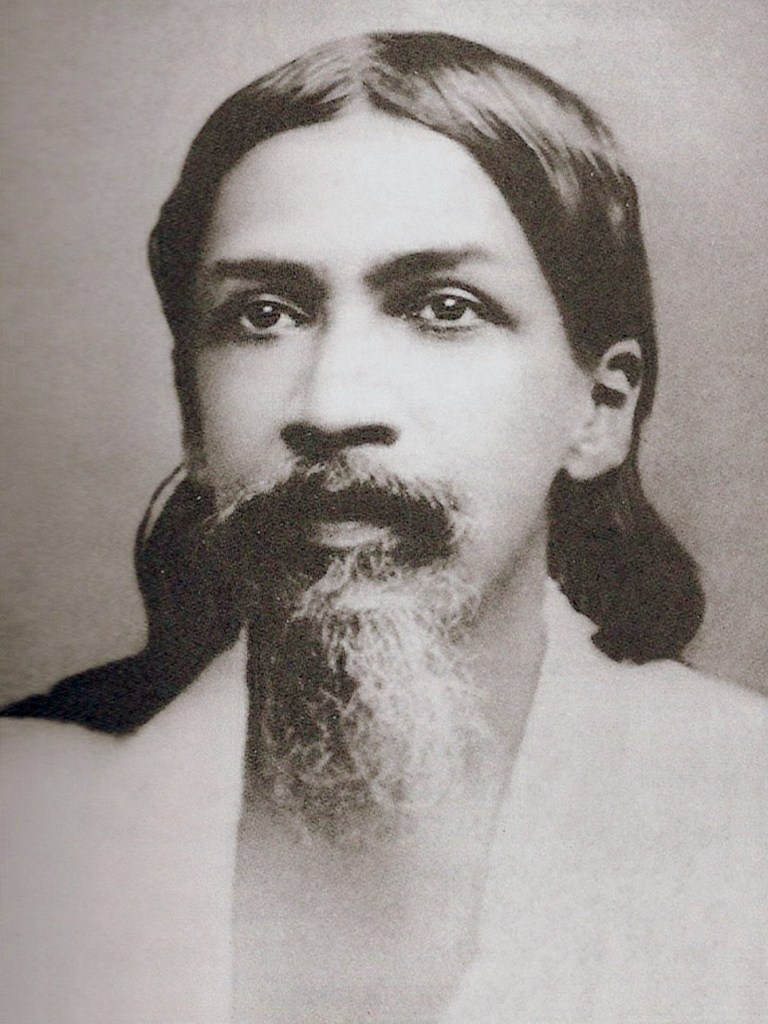
Aurobindo studied for the Indian Civil Service at King’s College, Cambridge, England. After returning to India he took up various civil service works under the Maharaja of the Princely state of Baroda and became increasingly involved in nationalist politics in the Indian National Congress and the nascent revolutionary movement in Bengal with the Anushilan Samiti. He was arrested in the aftermath of a number of bombings linked to his organization in a public trial where he faced charges of treason for Alipore Conspiracy. However Sri Aurobindo could only be convicted and imprisoned for writing articles against British colonial rule in India. He was released when no evidence could be provided, following the murder of a prosecution witness, Narendranath Goswami, during the trial. During his stay in the jail, he had mystical and spiritual experiences, after which he moved to Pondicherry, leaving politics for spiritual work.
At Pondicherry, Sri Aurobindo developed a spiritual practice he called Integral Yoga. The central theme of his vision was the evolution of human life into a divine life in divine body. He believed in a spiritual realisation that not only liberated but transformed human nature, enabling a divine life on earth. In 1926, with the help of his spiritual collaborator, Mirra Alfassa (referred to as “The Mother”), Sri Aurobindo Ashram was founded.
His main literary works are The Life Divine, which deals with the philosophical aspect of Integral Yoga; Synthesis of Yoga, which deals with the principles and methods of Integral Yoga; and Savitri: A Legend and a Symbol, an epic poem.
Philosophy and spiritual vision
Introduction
Sri Aurobindo’s concept of the Integral Yoga system is described in his books, The Synthesis of Yoga and The Life Divine. The Life Divine is a compilation of essays published serially in Arya.
Sri Aurobindo argues that divine Brahman manifests as empirical reality through līlā, or divine play. Instead of positing that the world we experience is an illusion (māyā), Aurobindo argues that world can evolve and become a new world with new species, far above the human species just as human species have evolved after the animal species. As such he argued that the end goal of spiritual practice could not merely be a liberation from the world into Samadhi but would also be that of descent of the Divine into the world in order to transform it into a Divine existence. Thus, this constituted the purpose of Integral Yoga. Regarding the involution of consciousness in matter, he wrote that: “This descent, this sacrifice of the Purusha, the Divine Soul submitting itself to Force and Matter so that it may inform and illuminate them is the seed of redemption of this world of Inconscience and Ignorance.”
Sri Aurobindo believed that Darwinism merely describes a phenomenon of the evolution of matter into life, but does not explain the reason behind it, while he finds life to be already present in matter, because all of existence is a manifestation of Brahman. He argues that nature (which he interpreted as divine) has evolved life out of matter and the mind out of life. All of existence, he argues, is attempting to manifest to the level of the supermind – that evolution had a purpose. He stated that he found the task of understanding the nature of reality arduous and difficult to justify by immediate tangible results.
Supermind
At the centre of Aurobindo’s metaphysical system is the supermind, an intermediary power between the unmanifested Brahman and the manifested world. Aurobindo claims that the supermind is not completely alien to us and can be realized within ourselves as it is always present within mind since the latter is in reality identical with the former and contains it as a potentiality within itself. Aurobindo does not portray supermind as an original invention of his own but believes it can be found in the Vedas and that the Vedic Gods represent powers of the supermind. In The Integral Yoga he declares that “By the supermind is meant the full Truth-Consciousness of the Divine Nature in which there can be no place for the principle of division and ignorance; it is always a full light and knowledge superior to all mental substance or mental movement.” Supermind is a bridge between Sachchidananda and the lower manifestation and it is only through the supramental that mind, life and body can be spiritually transformed as opposed to through Sachchidananda. The descent of supermind will mean the creation of a supramental race.
Affinity with Western philosophy
In his writings, talks, and letters Sri Aurobindo has referred to several European philosophers with whose basic concepts he was familiar, commenting on their ideas and discussing the question of affinity to his own line of thought. Thus, he wrote a long essay on the Greek philosopher Heraclitus and mentioned especially Plato, Plotinus, Nietzsche and Bergson as thinkers in whom he was interested because of their more intuitive approach. On the other hand, he felt little attraction for the philosophy of Kant or Hegel. Several studies have shown a remarkable closeness to the evolutionary thought of Teilhard de Chardin, whom he did not know, whereas the latter came to know of Sri Aurobindo at a late stage. After reading some chapters of The Life Divine, he is reported to have said that Sri Aurobindo’s vision of evolution was basically the same as his own, though stated for Asian readers.
Several scholars have discovered significant similarities in the thought of Sri Aurobindo and Hegel. Steve Odin has discussed this subject comprehensively in a comparative study. Odin writes that Sri Aurobindo “has appropriated Hegel’s notion of an Absolute Spirit and employed it to radically restructure the architectonic framework of the ancient Hindu Vedanta system in contemporary terms.” In his analysis Odin arrives at the conclusion that “both philosophers similarly envision world creation as the progressive self-manifestation and evolutionary ascent of a universal consciousness in its journey toward Self-realization.” He points out that in contrast to the deterministic and continuous dialectal unfolding of Absolute Reason by the mechanism of thesis-antithesis-synthesis or affirmation-negation-integration, “Sri Aurobindo argues for a creative, emergent mode of evolution.” In his résumé Odin states that Sri Aurobindo has overcome the ahistorical world-vision of traditional Hinduism and presented a concept which allows for a genuine advance and novelty.
Importance of the Upanishads
Although Sri Aurobindo was familiar with the most important lines of thought in Western philosophy, he did not acknowledge their influence on his own writings. He wrote that his philosophy “was formed first by the study of the Upanishads and the Gita… They were the basis of my first practice of Yoga.” With the help of his readings he tried to move on to actual experience, “and it was on this experience that later on I founded my philosophy, not on ideas themselves.”
He assumes that the seers of the Upanishads had basically the same approach and gives some details of his vision of the past in a long passage in The Renaissance of India. “The Upanishads have been the acknowledged source of numerous profound philosophies and religions,” he writes. Even Buddhism with all its developments was only a “restatement” from a new standpoint and with fresh terms. And, furthermore, the ideas of the Upanishads “can be rediscovered in much of the thought of Pythagoras and Plato and form the profound part of Neo-platonism and Gnosticism…” Finally, the larger part of German metaphysics “is little more in substance than an intellectual development of great realities more spiritually seen in this ancient teaching.” When once he was asked by a disciple whether Plato got some of his ideas from Indian books, he responded that though something of the philosophy of India got through “by means of Pythagoras and others”, he assumed that Plato got most of his ideas from intuition.
Sri Aurobindo’s indebtedness to the Indian tradition also becomes obvious through his placing a large number of quotations from the Rig Veda, the Upanishads and the Bhagavadgita at the beginning of the chapters in The Life Divine, showing the connection of his own thought to Veda and Vedanta.
The Isha Upanishad is considered to be one of the most important and more accessible writings of Sri Aurobindo. Before he published his final translation and analysis, he wrote ten incomplete commentaries. In a key passage he points out that the Brahman or Absolute is both the Stable and the Moving. “We must see it in eternal and immutable Spirit and in all the changing manifestations of universe and relativity.” Sri Aurobindo’s biographer K.R.S. Iyengar quotes R.S. Mugali as stating that Sri Aurobindo might have obtained in this Upanishad the thought-seed which later grew into The Life Divine.
Synthesis and integration
Sisir Kumar Maitra, who was a leading exponent of Sri Aurobindo’s Philosophy, has referred to the issue of external influences and written that Sri Aurobindo does not mention names, but “as one reads his books one cannot fail to notice how thorough is his grasp of the great Western philosophers of the present age…” Although he is Indian one should not “underrate the influence of Western thought upon him. This influence is there, very clearly visible, but Sri Aurobindo… has not allowed himself to be dominated by it. He has made full use of Western thought, but he has made use of it for the purpose of building up his own system…” Thus Maitra, like Steve Odin, sees Sri Aurobindo not only in the tradition and context of Indian, but also Western philosophy and assumes he may have adopted some elements from the latter for his synthesis.
R. Puligandla supports this viewpoint in his book Fundamentals of Indian Philosophy. He describes Sri Aurobindo’s philosophy as “an original synthesis of the Indian and Western traditions.” “He integrates in a unique fashion the great social, political and scientific achievements of the modern West with the ancient and profound spiritual insights of Hinduism. The vision that powers the life divine of Aurobindo is none other than the Upanishadic vision of the unity of all existence.”
Source: Wikipedia, Sri_Aurobindo
“The Spirit shall look out through Matter’s gaze / And Matter shall reveal the Spirit’s face.”[1]
Sri Aurobindo, Savitri: A Legend and a Symbol, Book XI: The Book of Everlasting Day, Canto I: The Eternal Day: The Soul’s Choice and The Supreme Consummation, p 709
 Via Perennis