

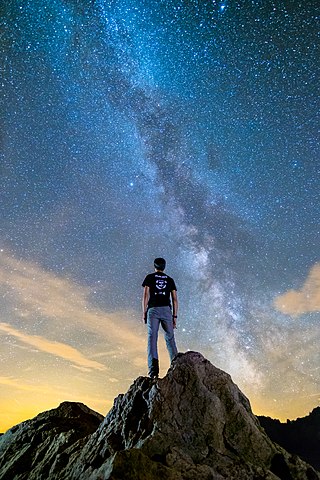
Looking at the clear blue sky, with uninterrupted gaze,
remaining completely still: all at once, O Goddess, one attains the ‘form’ of Bhairava. || 84
Imagine the entire sky as Bhairava, and that it is dissolved in
your head [so your head is continuous with and has the same
nature as the sky]. You will become completely permeated with
the reality of the radiant energy that is Bhairava’s nature. || 85
Meditate on the nature of the sky, unbounded & unconcealed in all directions, as identical to [the nature of] one’s own being.
Then the Power of Awareness, which [like the sky] needs no
external support, reveals your true nature. || 92
Excerpts from Vijnana Bhairava Tantra, translation: Christopher Wallis aka Hareesh
One of my favorite meditation practices, engaged in as a youngster and teen, long before I was aware of any spiritual path applications. The excerpts above were drawn from meditation instructions from a Tantric Hinduism text. But sky-gazing is also a practice employed by Dzogchen Buddhism, as outlined below:
In Dzogchen, sky gazing is one of the core practices of trekchö as well as tögal. Dzogchen is part of the Nyingma school of Tibetan Buddhism. Detailed instructions on the practice are provided by the Nyingma teacher Tarthang Tulku, among others.
In trekchö
As sky gazing can be practiced in different contexts, both trekchö and tögal, it can have multiple purposes. Like many other meditation techniques, one of the more superficial purposes is relaxation. Many people who meditate because of stress-related problems try to get out of their thoughts. Sky gazing meditation follows this intention by moving out of your thoughts, into space and emptiness. This can cause a calming effect because the practitioner learns to let go.
Lama Surya Das describes this in his book Natural Radiance: “Through this practice of natural meditative awareness, our innate wakefulness completely unfurls and reveals itself. We gradually release our small, narrow, egotistical, dualistic minds into the non-dual, sky-like, infinite Buddha mind, while meditating on the expansive, inclusive nature of rigpa: our natural wisdom-mind and innate wakefulness. In this practice, we merge the finite, thinking heart-mind with the absolute, unconditional infinity of essential Buddha-like being.”
He elaborates on that by explaining that the sky is perfect for this kind of release because of the spacious character of the sky. While our dualistic minds are concentrated on forms, the sky is an invitation to a state of formlessness. It is also a metaphor for timelessness. While the sky may have a changing content, the sky itself does not change. He also notes the connection with nature we gain from this practice. Not only with the physical nature, but our own true nature as well. This true nature will be observed because we dissolve into the open sky, showing we are one with the ‘infinite’.
[…]
In tögal
The true nature of our mind can also be shown in various luminous and bright-colored visualizations that are part of the tögal practice. These visions often include Tibetan symbols like deities and mandalas. This way of experiencing visions is very different from other visualization practices as it is not ‘building’ a vision of any kind and does not involve instruction. In Dzogchen, the practitioners have instant visions and realizations that are not guided and the goal is to ‘do’ as little as possible. Dzogchen doctrine believes in natural, self-arising liberation where the meditator is just allowing and recognizing the nature of mind.
The practice of sky gazing in this context leads to the four visions. These are, according to The Oxford Handbook of Meditation:
Vision of direct perception of reality.
Vision of increasing meditative experience.
Vision of the cultivation of awareness.
Vision of the cessation of clinging to reality.
At the end of the fourth vision, the practitioner will attain the rainbow body. This transition of letting go of the physical body is described as dissolving into space and light like ice melts into water.
Another teaching in tögal context is called ‘the six lamps.’ The practitioner realises different levels of light by sky gazing. These levels are described in Tibetan Yogas of Body, Speech, and Mind to be:
The vast infinite space that is the base of all.
The space within our heart centre.
The subtle channels connecting the heart with the eyes.
The space in our organs of perception.
The space in all external visions.
The space in the visions we experience in the bardo.
Source: Wikipedia, Sky-gazing (Dzogchen)
Related:
Landmarks: Terrain of the Quest – Lessons of a Sky-Gazer
 Via Perennis