

Roberto Assagioli (27 February 1888 – 23 August 1974) was an Italian psychiatrist and pioneer in the fields of humanistic and transpersonal psychology. Assagioli founded the psychological movement known as psychosynthesis, which is still being developed today by therapists and psychologists, who practice the psychological methods and techniques he developed. His work, expounded in two books and many monographs published as pamphlets, emphasized the possibility of progressive integration, or synthesis, of the personality.
Psychosynthesis
Inspiration and development
Assagioli is famous for developing and founding the science of psychosynthesis, a spiritual and holistic approach to psychology that had developed from psychoanalysis. He was largely inspired by Freud’s idea of the repressed mind and Jung’s theories of the collective unconscious. Trained in psychoanalysis but unsatisfied by what he regarded as its incompleteness as a whole, Assagioli felt that love, wisdom, creativity, and will all were important components that should be included in psychoanalysis. Assagioli’s earliest development of Psychosynthesis started in 1911, when he began his formal education in psychology. He continued his work on Psychosynthesis right up until his death. Freud and Assagioli were known to have corresponded, although they never had the chance to meet. Assagioli said, “Psychosynthesis presupposes psychoanalysis, or rather, includes it as a first and necessary stage.”
However, Assagioli disagreed with theories formulated by Sigmund Freud that he considered limiting. He refused to accept Freud’s reductionism and neglect of the positive dimensions of the personality. Psychosynthesis became the first approach born of psychoanalysis that also included the artistic, altruistic and heroic potentials of the human being. Assagioli’s work was more in alignment with psychologist, Carl Jung. Both Assagioli and Jung validated the importance of the spiritual level of human existence. Assagioli shared with Jung the insight that psychological symptoms can be triggered by spiritual dynamics. Assagioli considered Jung’s theories to be closest to his understanding of psychosynthesis.
Assagioli accredited much of his inspiration for psychosynthesis to his month-long incarceration in solitary confinement in 1940. He used his time in prison to exercise his mental will by meditating daily. He concluded that he was able to change his punishment into an opportunity to investigate his inner-self.
Psychology Today interview
In the December 1974 issue of Psychology Today, Assagioli was interviewed by Sam Keen, in which Assagioli discussed the differences between Freudian psychoanalysis and psychosynthesis:
We pay far more attention to the higher unconscious and to the development of the transpersonal self. In one of his letters Freud said, “I am interested only in the basement of the human being.” Psychosynthesis is interested in the whole building. We try to build an elevator which will allow a person access to every level of his personality. After all, a building with only a basement is very limited. We want to open up the terrace where you can sun-bathe or look at the stars. Our concern is the synthesis of all areas of the personality. That means psychosynthesis is holistic, global and inclusive. It is not against psychoanalysis or even behavior modification but it insists that the needs for meaning, for higher values, for a spiritual life, are as real as biological or social needs. We deny that there are any isolated human problems.
Assagioli noted that Carl Jung, “of all modern psychotherapists, is the closest in theory and practice to psychosynthesis”, and further expanded on the similarities between his own and Jung’s views:
In the practice of therapy we both agree in rejecting ‘pathologism’ that is, concentration upon morbid manifestations and symptoms of a supposed psychological ‘disease’. We regard man as a fundamentally healthy organism in which there may be temporary malfunctioning. Nature is always trying to re-establish harmony, and within the psyche the principle of synthesis is dominant. Irreconcilable opposites do not exist. The task of therapy is to aid the individual in transforming the personality and integrating apparent contradictions. Both Jung and myself have stressed the need for a person to develop the higher psychic functions, the spiritual dimension.
He also highlighted the differences between Jung’s work and psychosynthesis:
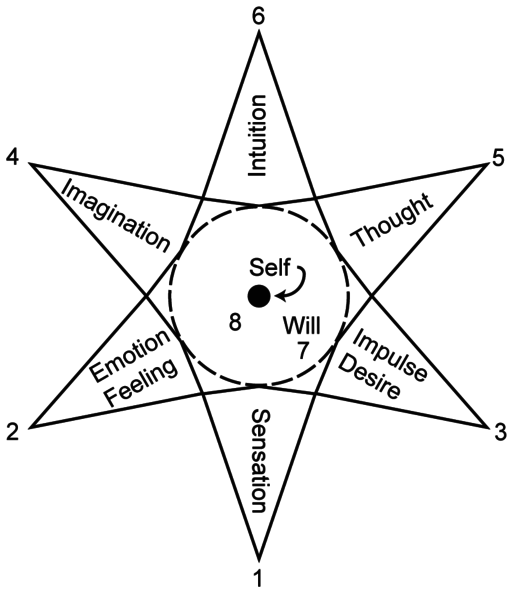
Perhaps the best way to state our differences is with a diagram of the psychic functions. Jung differentiates four functions: sensation, feeling, thought, and intuition. Psychosynthesis says that Jung’s four functions do not provide for a complete description of the psychological life. Our view can be visualized like this: We hold that outside imagination or fantasy is a distinct function. There is also a group of functions that impels us toward action in the outside world. This group includes instincts, tendencies, impulses, desires, and aspirations. And here we come to one of the central foundations of psychosynthesis: There is a fundamental difference between drives, impulses, desires, and the will. In the human condition there are frequent conflicts between desire and will. And we will place the will in a central position at the heart of self-consciousness or the ego.
Assagioli asserted about the will:
The will is not merely assertive, aggressive, and controlling. There is the accepting will, yielding will, the dedicated will. You might say that there is a feminine polarity to the will – the willing surrender, the joyful acceptance of the other functions of the personality.
At the end of the interview, Keen himself concluded:
It is hard to know what counts as evidence for the validity of a world view and the therapeutic it entails. Every form of therapy has dramatic successes and just as dramatic failures. Enter as evidence in the case for psychosynthesis an ad hominem argument: in speaking about death there was no change in the tone or intensity of Assagioli’s voice and the light still played in his dark eyes, and his mouth was never very far from a smile.
Spiritual work
Assagioli was also interested and active in the field of consciousness and transpersonal work. Having studied theosophy and Eastern philosophy, his written work developed different meditation techniques, including reflective, receptive and creative meditation. He also contributed to several spiritual groups in the tradition known as the “ageless wisdom.” He founded two groups intended to teach meditation based on the ideas of the New Age teacher Alice Bailey: The Group for Creative Meditation and the Meditation Group for the New Age. He was also a co-founder of the School for Esoteric Studies, intended to teach the work of Alice Bailey at an advanced level.
Source: Wikipedia, Roberto Assagioli
CRISES PRECEDING THE SPIRITUAL AWAKENING
In order to best understand the experiences that often precede the awakening, we must review some of psychological characteristics of the “normal” human being.
One may say of him that he “lets himself live” rather than that he lives. He takes life as it comes and does not question its meaning, its worth, or its purpose; he devotes himself to the satisfaction of his personal desires; he seeks enjoyment of the senses, emotional pleasures, material security, or achievement of personal ambition. If he is more mature, he subordinates his personal satisfaction to the fulfillment of the various family and social duties assigned to him, but without seeking to understand on what bases those duties rest or from what source they spring. Possibly he regards himself as “religious” and as a believer in God, but usually his religion is outward and conventional, and when he has conformed to the injunctions of his church and shared in its rights he feels that he has done all that is required of him. In short, his operational belief is that the only reality is that of the physical world which he can see and touch and therefore he is strongly attached to earthly goods. Thus, for all practical purposes, he considers his life an end in itself. His belief in a future “heaven,” if he conceives of one, is altogether theoretical and academic — as is proved by the fact that he takes the greatest pains to postpone as long as possible his departure for its joys.
But it may happen that this “normal man” becomes both surprised and disturbed by a change — sudden or slow — in his inner life. This may take place after a series of disappointments; not infrequently after some emotional shock, such as the loss of loved relative or a very dear friend. But sometimes it occurs without any apparent cause, and in the full enjoyment of health and prosperity. The change begins often with a growing sense of dissatisfaction, of lack, of “something missing.” But this “something missing” is nothing material and definite; it is something vague and elusive, that he is unable to describe…
CRISES FOLLOWING THE SPIRITUAL AWAKENING
…The inner experience of the spiritual Self, and its intimate association with the personal self, gives a sense of internal expansion, of universality, and the conviction of participating in some way in the divine nature. In the religious traditions and spiritual doctrines of every epoch one finds numerous attestations on the subject — some of them expressed in daring terms. In the Bible there is the explicit sentence, “I have said, Ye are gods; and all of you are children of the most High.” St. Augustine declares: “When the soul loves something it becomes like unto it; if it should love terrestrial things, it becomes terrestrial, but if it should love God does it not become God?” The most extreme expression of the identity of the human spirit in its pure and real essence with the Supreme Spirit is contained in the central teaching of the Vedanta philosophy: Tat Tvam Asi (Thou art That) and Aham evam param Brahman (In truth I am the supreme Brahman).
In whatever way one may conceive the relationship between the individual self, or “I,” and the Universal Self, be they regarded as similar or dissimilar, distinct or united, it is most important to recognize clearly, and to retain ever present in theory and practice, the difference that exists between the Self in its essential nature — that which has been called the “Fount,” the “Center,” the “deeper Being,” the “Apex” of ourselves — and of the little self, or “I,” usually identified with the ordinary personality, of which we are normally conscious. The disregard of this vital distinction leads to absurd and dangerous consequences….
Roberto Assagioli, Psychosynthesis
 Via Perennis