

Emerson’s astonishing essays first made themselves known to me as I worked in the western deserts on a botany project in 1986. I had tangentially been oriented to his work from my interest in Thoreau in the last year of college, and I had picked up (but not yet read) a paperback edition of Emerson’s works prior to heading out the the Great American West. There, with abundant free time, camped out in the Great Basin sagebrush day after day, and subliminally elevated by the endless still, sunny days with vast spaces laid out before my vision on an hourly basis, I was primed in a high degree to read his works with a pure and undistracted perception. His ideas sank deep into the still pool of my soul, clear impressions registering all the way to the bottom of that pool. Here was a man standing near and reporting on the view from the threshold of permanent spiritual elevation. His words and ideas still resonate clearly for Occidental minds today, more than 150 years later. Emerson was America’s sage and prophet.
Ralph Waldo Emerson (May 25, 1803 – April 27, 1882), who went by his middle name Waldo, was an American essayist, lecturer, philosopher, abolitionist, and poet who led the transcendentalist movement of the mid-19th century. He was seen as a champion of individualism and a prescient critic of the countervailing pressures of society, and his ideology was disseminated through dozens of published essays and more than 1,500 public lectures across the United States.
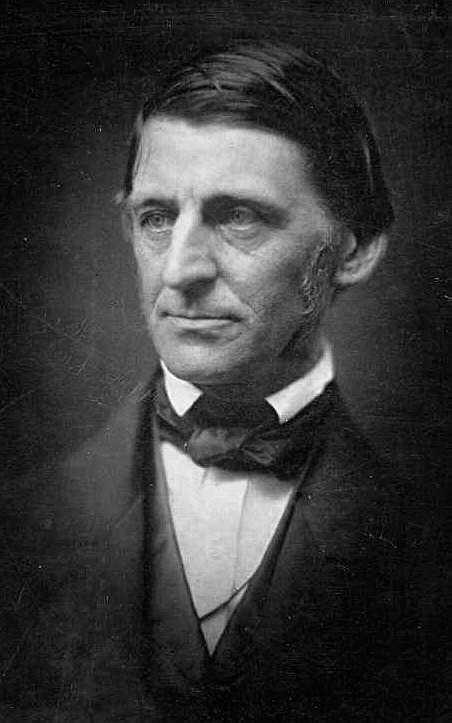
Emerson gradually moved away from the religious and social beliefs of his contemporaries, formulating and expressing the philosophy of transcendentalism in his 1836 essay “Nature”. Following this work, he gave a speech entitled “The American Scholar” in 1837, which Oliver Wendell Holmes Sr. considered to be America’s “intellectual Declaration of Independence.”
Emerson wrote most of his important essays as lectures first and then revised them for print. His first two collections of essays, Essays: First Series (1841) and Essays: Second Series (1844), represent the core of his thinking. They include the well-known essays “Self-Reliance”, “The Over-Soul”, “Circles”, “The Poet”, and “Experience.” Together with “Nature”, these essays made the decade from the mid-1830s to the mid-1840s Emerson’s most fertile period. Emerson wrote on a number of subjects, never espousing fixed philosophical tenets, but developing certain ideas such as individuality, freedom, the ability for mankind to realize almost anything, and the relationship between the soul and the surrounding world. Emerson’s “nature” was more philosophical than naturalistic: “Philosophically considered, the universe is composed of Nature and the Soul.” Emerson is one of several figures who “took a more pantheist or pandeist approach by rejecting views of God as separate from the world.”
He remains among the linchpins of the American romantic movement, and his work has greatly influenced the thinkers, writers and poets that followed him. “In all my lectures,” he wrote, “I have taught one doctrine, namely, the infinitude of the private man.” Emerson is also well known as a mentor and friend of Henry David Thoreau, a fellow transcendentalist.
Emerson’s religious views were often considered radical at the time. He believed that all things are connected to God and, therefore, all things are divine. Emerson was partly influenced by German philosophy and Biblical criticism. His views, the basis of Transcendentalism, suggested that God does not have to reveal the truth, but that the truth could be intuitively experienced directly from nature. When asked his religious belief, Emerson stated, “I am more of a Quaker than anything else. I believe in the ‘still, small voice’, and that voice is Christ within us.”
In May 2006, 168 years after Emerson delivered his “Divinity School Address”, Harvard Divinity School announced the establishment of the Emerson Unitarian Universalist Association Professorship. Harvard has also named a building, Emerson Hall (1900), after him.
Source: Wikipedia
 Via Perennis