

In Eastern or Western spiritual work [an] imbalance manifests as working on spiritual development without taking care of one’s psychological conflicts and aberrations. So one may develop deep spiritual experience and insight, but retain some neurotic and emotionally conflicted manifestations.
The Inner Journey Home, A.H. Almaas
In the past, religious and spiritual traditions dealt with these manifestations through moral and ethical purification…However, psychological understanding shows us that even moral and ethical purification might not be effective in dealing with deep-seated neurosis, or what is called structural weakness in the ego….
It is obvious that such aberrant behavior indicates a psychological disturbance that is bound to influence and distort our spiritual attainment. This points to the need to include our sophisticated psychological understanding in our spiritual training…It seems that the time has come for a new integration of the understanding of psychology with spiritual understanding.
By far the most profound and eye-opening discovery back here in “relative reality” after my spiritual opening was just how unprepared and uni-dimensional I was in my personal psychological structures, all of which was mercilessly exposed during the transformational fire. I had many deficiencies, both in terms of personal lines of growth and maturity that had been stunted or were congenital in nature, but more importantly, I had many experiences held in the body-mind matrix down through the years – traumas of various types – that had never been properly digested and assimilated by my being. It wasn’t due to a lack of effort; I had had counseling and therapy in my years struggling with depression in the 80s, and I had attempted to learn all I could in an intellectual sense about personal growth and maturation. I had a fair amount of self-awareness and insight into my personal make-up, as far as I had explored at least. But the methods available to make progress in psychological growth either didn’t exist in my orbit at the time, or they flatly were not effective in helping me to digest my previous traumas. The effect of the opening with all of these obstacles being held in my field was similar to a that of a wildfire encountering new pockets of fuel – not only did they amplify the intensity of the opening experience, but when those pockets of fuel are primarily negativity held on to in some form, subconsciously or consciously, the effect for the egoic structures that are the source fuel for the fire is the amplification of content that is the essence of the negativity. In my case, that meant escalations of fear, terror, and the self-perception of extreme weakness in maintaining a stance as a human being in the midst of the firestorm.
In the years afterward, I discovered that the general lack of true trauma processing was not unique to me; traumatized individuals in all forms and degrees are the rule, not the exception in the human race. Sadly, many people are either so pre-occupied with their traumas and how to cope with them day-to-day, or so broken and incapacitated by their traumas, that their personal growth, let alone the possibility of transcendent growth, is brought to a complete standstill by unresolved psychological issues. I became convinced the more that I studied the matter that any creed or philosophy that did not give due attention to meeting people where they were and offering real, effective and compassionate psychological assistance in the here and now was doing a grave disservice to its adherents. This means spiritual solutions coming from scriptures and sacred texts were not and are not enough; there needed to be a suite of effective tools, whether spiritual or secular in origin, that were able to free the personal vehicle from the mud pit it was mired in.
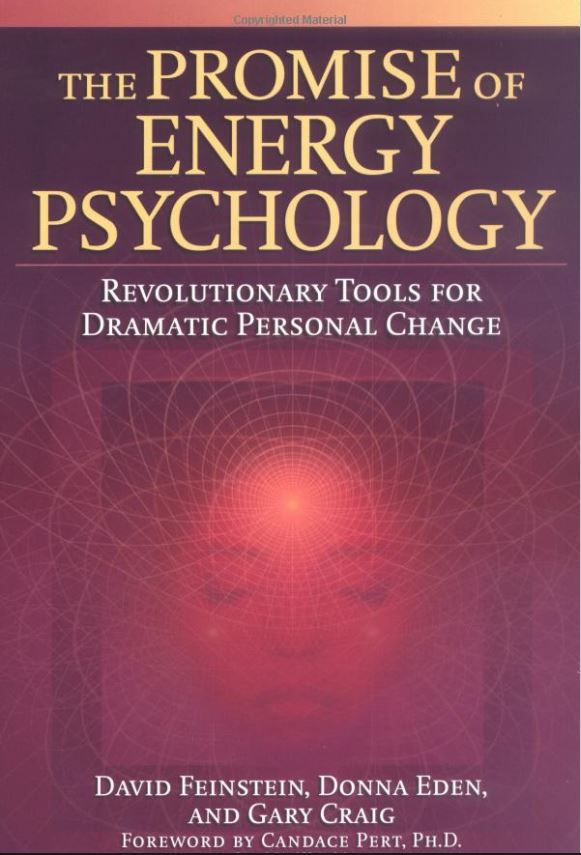
This was when I discovered energy psychology. My first exposures to the broader field of active, present-centered energy medicine came in 1999, prior to my opening, when I happened upon Donna Eden’s book Energy Medicine and attended a 1/2 day workshop she presented in a location near me. Donna was a gifted and extremely personable healer who was born with native talents that allowed her to see people’s energy systems and tell whether there were energy system blockages hampering their health. Her husband, David Feinstein, a clinical psychologist, was operating on a parallel path trying to bring interventions in psychology into a 21st century energy paradigm with his 2005 work The Promise of Energy Psychology.
One description of energy medicine:

Energy medicine is based upon the belief that changes in the “life force” of the body, including the electric, magnetic, and electromagnetic fields, affect human health and can promote healing.
Energy medicine article, https://www.encyclopedia.com/medicine/encyclopedias-almanacs-transcripts-and-maps/energy-medicine
Energy medicine is a broad term that includes touch therapies, movement therapies, spiritual healing, meditation , magnetic field therapy, homeopathy, acupuncture, light therapy , and other innovative methods of healing. What these various approaches have in common is an energetic understanding of health and healing. These therapies may affect the patient’s internal energy, external energy (aura, or other energy fields surrounding the body) or both. Many of these therapies fall into several different categories at once and their benefits may not be exclusively due to changes in life force. Energetic touch therapies include, but are not limited to, reiki, therapeutic touch (although the physical body is not touched), watsu, polarity therapy , Ayurvedic massage, zero balancing, reflexology , Jin Shin Jyutsu, lomilomi, breema bodywork, Thai massage, shiatsu , amma, Chi Nei Tsang, Jin Shin Do, Shen, and Chinese massage , and acupressure . Energetic movement therapies include qigong, t’ai chi chuan, aikido, karate, and yoga (there are many different forms of yoga). Spiritual healing includes distance healing, laying on of hands, meditation, ceremony, ritual, and other shamanic practices.
Energy psychology may be considered a subset of energy medicine, drawing its content both from understandings of human psychology and energetic interventions modeled on the ancient Chinese understanding of the human meridian system:
Energy psychology, also known as cognitive somatic practices, comprises a family of mind-body methods designed to strategically and methodically intervene with human energy fields in elevating physical, mental, emotional and spiritual wellbeing.
Energy psychology (EP) methods combine cognitive interventions with somatic techniques that influence the human bio-energy systems such as meridians, chakras and the biofield, as well as subtler systems of the body such as neuroception. Activation of these systems during the intervention is thought to increase the speed and/or thoroughness of the work.
These approaches are used by practitioners of psychotherapy, counseling, coaching, energy healing, and health optimization.
Practitioners view symptoms as systemic, interactive bio-energetic patterns. This involves constant complex communication among neurobiological processes, electrophysiology, consciousness, and bioenergy systems. Energy psychology (EP) helps people shift the flow of information and energy throughout these systems to facilitate healing and growth.
Most EP approaches are brief, active and structured. EP approaches can be: 1) used as stand-alone interventions, and 2) easily integrated within a broader clinical treatment, program of change or health optimization. Clients also learn self-help techniques they can use themselves.
EP approaches are often rapid, have little to no adverse effects, and are usually experienced as self-empowering by clients and patients.The most common examples of energy psychology methods are: Emotional Freedom Techniques (EFT), Thought Field Therapy (TFT), Tapas Acupressure Technique (TAT), Comprehensive Energy Psychology (CEP), Advanced Integrative Therapy (AIT), and Heart Assisted Therapy (HAT).
Association for Comprehensive Energy Psychology, https://www.energypsych.org/energy-psychology
In essence these original EP methods were an intentioned use of acupressure-based methods focused on traumatic events or memories.
Having awakened to and experienced my own energy field dramatically and vividly in the opening, and having had prior exposure to the thought paradigms behind the methods, I needed no further persuasion that these methods might be worth trying. I was certainly willing to do so; it wasn’t as if I was leaving behind any psychological modalities or tools that had actually been helpful, let alone curative, to me previously. I set about exploring what might work, both on my own and with the help of a practitioner. Did they ever work! The following is a synopsis of what I found:
- Emotional Freedom Technique™: Excellent for addressing specific, discrete event-based traumas.
- Seemorg Matrix Work™: For addressing related constellations of internalized limiting belief systems around various issues
- Emotional Complex Clearing: For hard-to-isolate feelings or somatic reactions that cannot be easily apprehended or addressed with the other two methods.
- Eye Movement Desensitization and Reprocessing (EMDR): The granddaddy of energy-related methods. For addressing PTSD and any “stuck” emotional issue that hasn’t been surmounted and resists being dislodged.
Using all of these methods at one time or another, I combed back through my personal history with an exhaustive inventory and addressed every issue uncovered that was still bothering me, in some cases even decades later. Also undertaken was the identification of matrices or suites of related limiting beliefs and hang-ups that were thwarting psychological growth and progress, and the addressing of these as identified using the methods. The results were deeper and more far-reaching than I could have ever imagined. In a period of months, I grew and progressed further than in all the previous decades of intermittent counseling and personal work. I slept better, had more personal enthusiasm and vitality than before, and was more at peace and able to engage more fully with others. On the spiritual level, I could feel the smoothing-out of wrinkles and condensed pockets of resistance in the substratum of my being as the personal work progressed, and the deepening and further rooting of the new state of consciousness. Tremors and fasciculations which had been prominent in the early stages of the transition gradually abated as more and more obstacles were identified, addressed, and resolved; other body therapists and healing arts practitioners working with me during the time confirmed this from their perspectives as well.
While talk therapy has its place in increasing a person’s insight into their issues, it is usually not enough on its own to resolve issues for people, particularly traumatic ones that cause the most misery for sufferers. Where it does work, it is painfully slow, in many cases taking years of a gradual desensitization and reframing of the issue from a first-person perspective. And it’s easy to understand why it is relatively ineffective upon reflection – we are not simply minds and vocal cords, but multi-dimensional, energetic and incarnated beings. We do not simply store emotions in our heads, but hold them in many loci in the body itself. Incorporating a perspective based on energy and working directly with it was the key to unlocking the access and addressing the whole person, getting the patterns unstuck, so things could begin moving forward again. These tools were the ‘open sesame’ that removed or vastly diminished the obstacles in my personal psychological make-up that had made for such a tumultuous transition in consciousness.
As such, energy psychology tools and techniques actually are and should be considered, in my view, a cornerstone engagement for achieving emotional stability and sound personal development to ensure a well-rounded and prepared human vessel for noetic journeys of all types. We are all damaged, in greater or lesser degree, by the vicissitudes of life. Doesn’t it make sense to repair that damage to the extent that we can to optimize our possibilities of growth?
 Via Perennis