

An Introduction to the Big Picture

For those in the West actively seeking spiritual growth and experience who find themselves outside of any one given tradition, whether by choice or choice-less native development, there is not much structured commentary or guidance available. This is a select population who is under-served and left to their own devices in their search. Yes, there’s a thriving spiritual marketplace, through books, workshops, and videos, and there is much of very great value to be found and syncretically assimilated from various Western wisdom traditions, including the mainstream religions – Christianity, Judaism, and Islam. But the task of sifting, assimilating and structuring from what can be a bewildering array of possible directions and orientations falls to the individual. Further compounding the challenge, it is increasingly difficult in a fast-paced, commercial and utilitarian Western culture to find enough space, quiet, and an organized inner orientation to cultivate a spiritual life. There are few “lifeboats” available to such seekers, certainly no desert retreats, convents, monasteries or other protected places these days where sincere non-traditional seekers can retreat from the world, learn, grow deliberately, self-cultivate and pursue their inner muses. Those refuges that do exist are generally available only to those of their own particular religions or schools or are for-profit enterprises offered only periodically on a short-term basis. This is the challenge of our time and culture in an increasingly fast-paced, secular and materialistic world – the sheltering frameworks of religious institutions are slowly losing viability over time in Western cultures, and new wineskins are needed to hold advancing spiritual understandings from all cultures across all eras. Simultaneously, there is less and less space – exteriorly and culturally – available to thrive spiritually. What advances are made in spirituality for Western humanity in the present and coming generations will necessarily have to happen in the given environment.
Who is this for, then?
Although anyone who finds this material and these ideas helpful is welcome to partake of them, Via Perennis is especially appropriate and useful for non-traditional spiritual seekers. These seekers have one or more of three identifying characteristics. The first characteristic is that seekers tend to consider themselves Spiritual but not religious. According to a 2017 Pew poll, an increasing percentage of Americans surveyed have reported this orientation towards their faith in recent years. More than a quarter (27%) now feels this phrase characterizes their orientation. My personal inclination is to slightly modify this phrase to Spiritual and/or not (necessarily) religious; there’s much of value to be gleaned from religious traditions, and it’s not necessary to throw out the baby with the bathwater. But at the same time, for non-traditional seekers, limiting one’s insights and growth path to those constrained by one religion, or to religion alone, leaves a lot of wisdom and growth potential on the table, unacknowledged and unassimilated. There’s also another distinction that can be drawn on the population of spiritual practices evolving in the West, summed up by the phrase Experiential, not belief-based. Cleaving the gemstone of Occidental spiritual/religious faiths along this facet presents a different view and a different subset of Westerners – some within a formal religious tradition, some outside of one, who have experienced or aspire to experience direct spiritual knowledge – i.e., mystical or gnostic content – and are not content with stopping at a merely discursive knowledge or set of beliefs about the nature of God and the cosmos. And yet one more cut is illustrative – a group that adopts an attitude towards their faith of Active pursuit, not passive engagement – favoring the recognition that a vigorous effort on the individual’s part in pursuit of the Experiential is called for, and an energetic engagement in implementing that effort. For the manifestation of this gleaming facet, proponents feel that it is not enough to be lukewarm towards the object of one’s veneration and remain stationary in one’s personhood; it is insufficient to tepidly pronounce one’s faith and decline to undertake any additional effort. In other words, salvation is not a vicarious enterprise. As the Buddha infamously stated, “Behold, O monks, this is my advice to you. […] Work hard to gain your own salvation.” And Christ five centuries later (Gospel of Thomas, Logion 70) stated the same idea in a different context: “If you bring forth what is within you, what you have will save you. If you do not have that within you, what you do not have within you [will] kill you.” The advice from these two Human Lights has resonated down through the centuries.
A Western syncretic approach may sometimes carry, fairly or not, the reputation of being “dilettante” spirituality, through recent decades of some pursuing casual and even self-indulgent aims; many New-Age practices are somewhat notorious for these attitudes. But a true and honest integral and syncretic practice demands the utmost in personal devotion, aspiration, and applied effort, an undeniable sincerity and gravity of purpose, in order to be successful. This is serious business; this presentation is emphatically not a smorgasbord where one can freely sample bits and bites of various spiritual delicacies for one’s personal pleasure, diversion and amusement. The end goal of the endeavor is spiritual Transformation or Realization. The measure of the ultimate success, the final exam of the merit of one’s spiritual practice and development comes upon entry into the transpersonal realm; that exam can be exceptionally searing and grueling for those not adequately prepared, purified and properly respectful of the power of the trans-egoic realms. It can relentlessly plumb one’s depths and test the sincerity of one’s motivations and consecration to the goal. Ultimately, the success of the endeavor depends on the resilience, preparedness, heart and purity of motive of the practitioner, and the character of those traits is determined long before one actually crosses the threshold. One is counseled in this effort to be always mindful of one’s innermost intention and to be a faithful steward of that inner consecration.
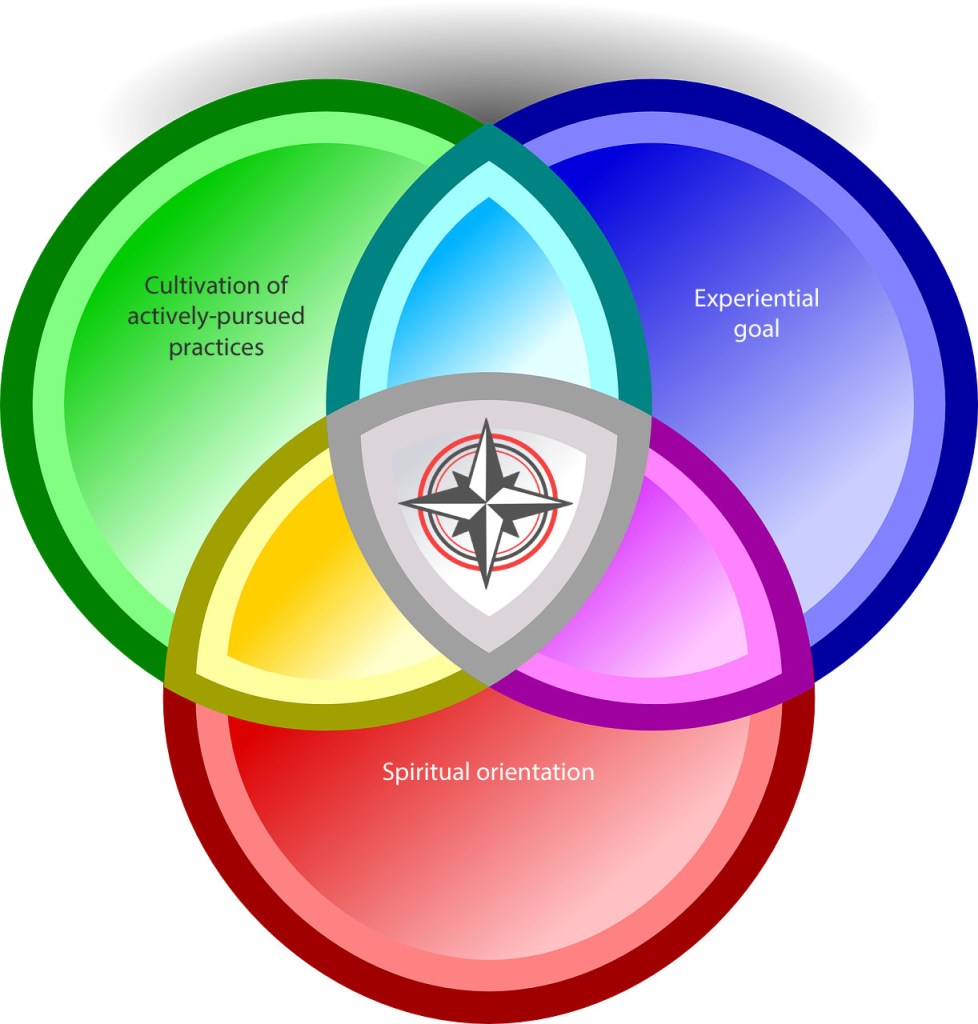
In summary, then, the three earmarks of this approach are
- Spiritual and/or not (necessarily) religious
- Experiential, not belief-based
- Actively pursued, not passively engaged
Or, stated more positively and cogently, the three identifying facets of this template for a practice are:
- A Spiritual orientation
- An Experiential goal
- The Cultivation of actively-pursued practices
If these three facets describe or intrigue you, this website is tailored for your benefit. Via Perennis offers a framework by which you can begin to conceive of, consider, order, and structure an effective Western spiritual practice suitable to an Occidental temperament. The framework is flexible and adaptable in its broadest conception, based loosely on the perennial philosophy and expanded to incorporate an integral sadhana or spiritual practice – a Western spirituality based on the cornerstones of the physical, the emotional/psychological, the intellectual, and the spiritual – thus Body, Heart, Mind and Spirit. And at the unspoken intersection of these four cornerstones is the Soul, the central axis mundi of the human’s encounter with the Divine, the Inner Light. The compass rose is the central motif of Via Perennis, for it’s ultimately all about orientation, an integral scope, and a consciously-chosen path with a clear direction and visible growth and progress, both to oneself and within one’s larger community. I invite you to explore the guiding perennial philosophy here and the essential core of Via Perennis here. Via Perennis – An integral spiritual practice for Occidental hearts, souls and minds. Welcome! Let’s explore together.
 Via Perennis