

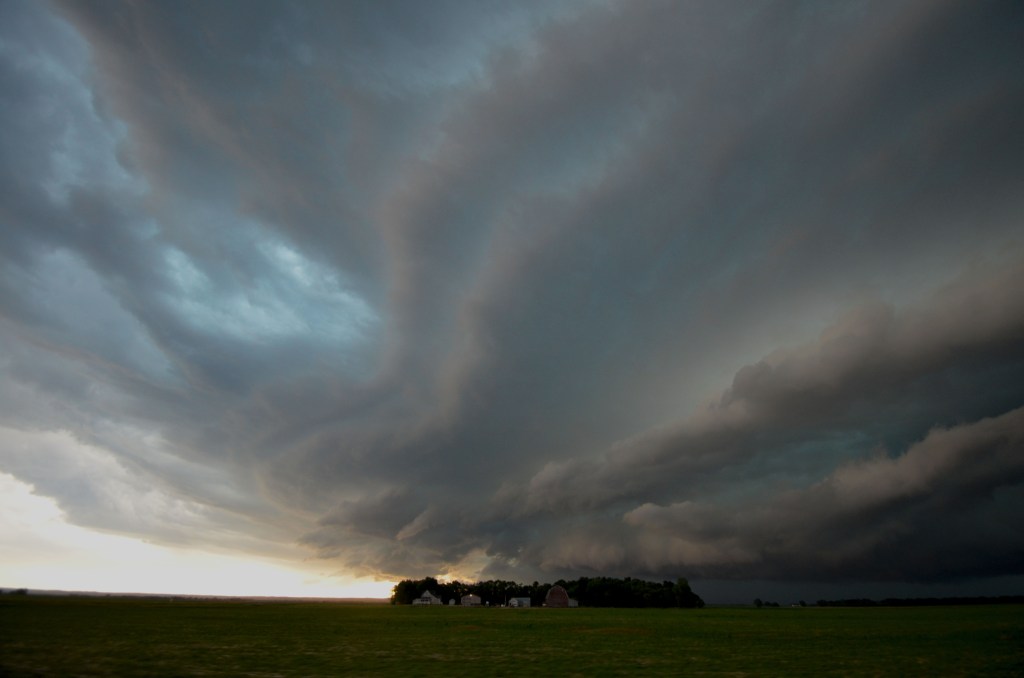
Storm rolling in.
Advancing nimbostratus on the horizon, a long, low, dark line. A good place to start. If you study this bank intently for a few minutes, your perception will shift, and you’ll swear to seeing breakers rolling in on a beach, frothing on a compact leading edge. Use this cue. Practice with it. Take the perception back and forth, voluntarily, consciously. See breakers; now shift, see stratus clouds. Breakers; stratus. Again. Good. Keep working on that.
If you didn’t know by now, let me tell you this. Your reputation will suffer for the sake of this love. You will be called lazy and irresponsible. People will wonder why you neglect their duties to wander in the fields afternoons and why you disappear at night. You will be questioned and lectured. Friends may desert you. Your family may become more distant and formal. You may become something of the town fool. Those who don’t know you will point and whisper on the streets. Your acquaintances will be more courteous, but you won’t be able to avoid their quizzical looks. These things will always be a source of distress for you, and it does not get any easier with time. It’s best that you see it now: sky-gazing is a costly business.
I’ve never regretted getting into this line of work.
One of the biggest problems I had as an amateur sky-gazer was the earth beneath my feet. I had a habit of staring off into space instead of watching where I was going. It became a common sight around town: the daydreamer walking into a light pole or catching a toe on uneven sidewalk joints. More than once, I found myself sprawled out into the street after falling off a curb. Bystanders would graciously help me to my feet and caution me to watch my step. The reminders were painful. I wanted to forget my clumsy feet. I didn’t want to see my grimaces reflected in the eyes of well-meaning bystanders. Eventually, out of embarrassment, I began to mind their advice. I learned to keep my eyes down, avoid the light poles, space my steps on the sidewalks, things any child learns early on walking home from school. I didn’t fall anymore, but within days I lost the spring in my step. It was too great a price to pay. I had to escape. I fled town for the wilds where I could stumble all day without fear of reprimand. In time, I learned through painful trial and error how to walk and sky-gaze at the same time. I still carry the aches of old injuries from those early days.
Relax now. Your exercise with the nimbostratus will continue on some level beyond your awareness, like a mantra that resonates after the chanting stops. Focus your attention on the mid-level clouds ahead of the stratus, the altocumulus puffs in the unstable air ahead of the front, ragged like teased cotton balls. Pick one. Look at the edges. Hard, isn’t it? Like holding on to quicksilver. Disorienting – these clouds blossom and melt endlessly. After a while, you begin to wonder if these shapeshifters have an identity. When that one vanishes, start on another one. Try to guess where the new ones will appear. This is excellent training. Edges, definition, identities, the hard logic of dichotomy: none of these apply to this ocean of flux overhead. If you want to understand what’s going on up there, you’ll have to realize you’ve been seeing with your mind for years. Don’t think. Don’t categorize. Watch.
It was a struggle from the start to find my place. The mountains called first. I followed the call without questioning, like the naive disciple of a false teacher. It was the first in a long string of disappointments. I hadn’t given enough thought to the practical considerations of alpine sky-gazing. Summer lightning storms chased me under cover daily. When the skies cleared, the glare from the snowfields above timberline blistered my face and burned my eyes into snow blindness. Winter fronts entombed me under a sheet of gray for days on end. The peaks and ridges that gave moments of horizon-to-horizon vistas when I stood on top of them stole weeks from the work at hand when they stood over me. The lows were not balanced by the highs. Very soon, I felt an acute need for a leveling perspective.
I was tempted to head for the lowland forests. Shade. Comfort. Mild temperatures. The soothing songs of birds. Places to sit against the bases of oaks and maples to study the sky. The attraction was strong, but the apparent comfort of the place made me wary. It would have been so simple to settle for a glade where only ragged patches of the sky were visible through the leaves, so easy to slide from that sitting position against the tree onto my back, so comfortable to let the humidity sedate me. I knew myself only dimly, but well enough to know that I needed an edge to work against, some discomfort to keep me honest and earnest. I didn’t need to sleep; I needed to awaken.
There was no place left for me but the desert.
Going there seemed a tremendous sacrifice at the time. I felt a great poverty in the wide-open spaces. I hated the desert at first, cursed it, called it a God-forsaken place. The seasons were murderous; summer, yes, I expected to be uncomfortable, but the frigid winters blind-sided me. The wind caused me to doubt my sanity. It was as close as I came to giving up the profession. But in due time, I began to see that the climate and topography were more favorable to my purpose. Nothing was hidden; nothing was held back.
Look higher now at the mares’ tails, rippling back and forth over the minutes like sedges in a pond’s waves. Watch how these ribbons move forward, as if being pulled by an invisible hand. Watch them vanish along a uniform line ahead of the front. I always get the feeling we are seeing the secret of perpetual motion here, a progression that never advances, a motion that turns back on itself beyond our view. Imagine this procession in a fast-forward mode. Project that motion before your mind’s eye and meditate on it. These are powerful images; before long, you will realize you have been watching an ethereal organism, a being with the attributes of life: movement, growth, passing, even something akin to purpose.
© Copyright DH McCarty and viaperennis.wordpress.com, 2022. Unauthorized use and/or duplication of this material without express and written permission from this site’s author and/or owner is strictly prohibited. Excerpts and links may be used, provided that full and clear credit is given to the author/owner with appropriate and specific direction to the original content.
 Via Perennis