

Integral yoga was Sri Aurobindo’s gift to humanity’s spiritual possibilities, based upon his own development and spiritual unfolding. It is encapsulated by the phrase “All life is yoga!” Here in the West, we tend to have a limited and partial view of yoga, thinking of it as a set of physical postures, stretching exercises, and perhaps some breathing regulation, but as understood in the Eastern traditions, yoga was very much a comprehensive spiritual calling, encompassing all major aspects of a person’s spiritual life. In the West, the nearest analogy would be the totality of one’s religion. Aurobindo’s conception of yoga went beyond even this, expanding the field of consideration from the spiritual life alone, with all of the artificial boundaries that normally implies, to all major aspects of a human life, including the heart and devotional aspiration (bhakti yoga), knowledge in all of its forms, but particularly knowledge oriented towards the spiritual realm (jnana yoga), and work or action (karma yoga). Consolidating all of these made for a much more comprehensive yoga – which he termed the Integral Yoga.
Integral Yoga was the prototype and forerunner of a spirituality that is increasingly being referred to in the West as Integral Theory (further developed and synthesized in its Western expression by Ken Wilber) and Integral Spiritual Practice. Via Perennis as a spiritual template falls well within the scope of this school of Integral Spiritual Practice.
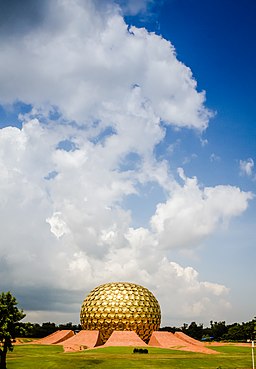
India, CC BY-SA 2.0 https://creativecommons.org/licenses/by-sa/2.0,
via Wikimedia Commons
Integral yoga, sometimes also called supramental yoga, is the yoga-based philosophy and practice of Sri Aurobindo and The Mother (Mirra Alfassa). Central to Integral yoga is the idea that Spirit manifests itself in a process of involution, meanwhile forgetting its origins. The reverse process of evolution is driven toward a complete manifestation of spirit.
According to Sri Aurobindo, the current status of human evolution is an intermediate stage in the evolution of being, which is on its way to the unfolding of the spirit, and the self-revelation of divinity in all things. Yoga is a rapid and concentrated evolution of being, which can take effect in one life-time, while unassisted natural evolution would take many centuries or many births. Aurobindo suggests a grand program called sapta chatushtaya (seven quadrates) to aid this evolution.
Spirit – Satchitananda
Spirit or satchitananda is the Absolute, the source of all that exists. It is the One, having three aspects: Sat (truth), Citta (consciousness, awareness), and ananda (bliss, happiness).
Involution
Involution is the extension of Spirit, the Absolute, to create a universe of separate forms. Being manifests itself as a multiplicity of forms, meanwhile becoming lost in the inconscience of matter. The first manifestation of Spirit in the process of involution is as Satchitananda, and then as Supermind, the intermediate link between the higher (Spirit) and lower (matter, life, and mind) nature.
According to Aurobindo the world is a differentiated unity. It is a manifold oneness, that generates an infinite variety of lifeforms and substances. The lifeforms and substances are stretched out on a wide range, from physical matter to a pure form of spiritual being, where the subject becomes fully aware of itself as spirit:
Material– a submerged consciousness concealed in its action and losing itself in the form.
Vital– an emerging consciousness, a consciousness half delivered out of its original imprisonment which has become of vital craving and satisfaction or repulsion.
Mental– an emerged consciousness reflecting fact of life in a mental sense, perceptive & ideative. It modifies the internal and attempts to modify conformably the external existence of the being.
Above Mind proper lie various higher levels of Mind, which ascend toward Spirit.
Evolution
Through evolution Spirit rediscovered itself as Spirit. Evolution follows a developmental trajectory from the original inconscience of matter into life, to mind, and then to spiritualized mind, culminating in The Supermind or Truth Consciousness. Evolution is teleological, since the developing entity contains within itself already the totality toward which it develops. It is not a mechanistic or deterministic teleology, but a “manifestation of all the possibilities inherent in the total movement.”
The goal of integral yoga
The goal of Integral yoga is to become aware of the Divine, to integrate the physical, mental and spiritual aspects of ourselves, and to manifest the Divine on earth. According to Sri Aurobindo, all life is Yoga, while Yoga as a sadhana is a methodized effort towards self-perfection, which brings to expression the latent, hidden potentialities of being. Success in this effort unifies the human individual with the universal and transcendental Existence. Integral yoga reunites “the infinite in the finite, the timeless in the temporal and the transcendent with the immanent.”
Practices
Unlike other Yoga practices Integral yoga does not propose any kind of physical asanas, breathing techniques or external movements. It is more psychological in nature, with internal reflection and self analysis & correction as main tools of development .
The main practices or approaches are divided into
The Yoga of divine work (yoga through ones work )
The Yoga of Integral Knowledge ( Yoga through analysis, observation & knowledge)
The Yoga of Divine love ( Commonly referred to as Bhakti yoga or love of god)
The Yoga of Self-Perfection (referred to as a Synthetic yoga or the triple way )
The Yoga of Self-Perfection
The Triple Transformation
The limitations of the present being can be overcome by the Triple transformation, the process in which the lower nature is transformed into the divine nature. It consists of the inward psychicisation by which the sadhak gets in contact with the inner divine principle or Psychic Being; the spiritual transformation or spiritualization; and the Supramentalisation of the entire being.
Supramentalisation
The supramental transformation is the final stage in the integral yoga, enabling the birth of a new individual, fully formed by the supramental power. Such individuals would be the forerunners of a new supra-humanity, grounded in truth-consciousness. All aspects of division and ignorance of consciousness, at the vital and mental levels, would be overcome, and replaced with a unity of consciousness at every plane. And even the physical body transformed and divinised. A new supramental species would then emerge, living a supramental, gnostic, divine life on earth.
Aurobindo describes several results and different stages depicting the stages of development in integral yoga, called together the sapta chatushtaya, “seven quadrates.” It consists of:.
Shanti (peace, calm), which consists of samatha (calming of the mind), shanti (peace), sukha (happiness), and hasya (Atmaprasada, contentment of the Atman);
Shakti (power), which consists of shakti (the power of the primordial energy), virya (energy, effort), daivi prakriti (Divine Nature, primal force), and sraddha (faith);
Vijnana (knowledge), which consists of jnanam (knowledge), trikaladrsti (knowledge of past, present and future), ashtasiddhi (eight powers), and samadhi (absorption);
Sharira (body), which consists of arogyam (health), utthapana (levitation, being free from gravity and physical powers), saundaryam (beauty), vividhananda (bliss);
Karma (divine work), which consists of Krishna (avatar of Vishnu), Kali (the Goddess), kama (divine delight), and Karma (divine action);
Brahma, the realization of Brahman;
Siddhi (realization), which consists of shuddhi (purification), mukti (liberation), bhukti (enjoyment), and siddhi (realisation of yogic powers).
 Via Perennis