

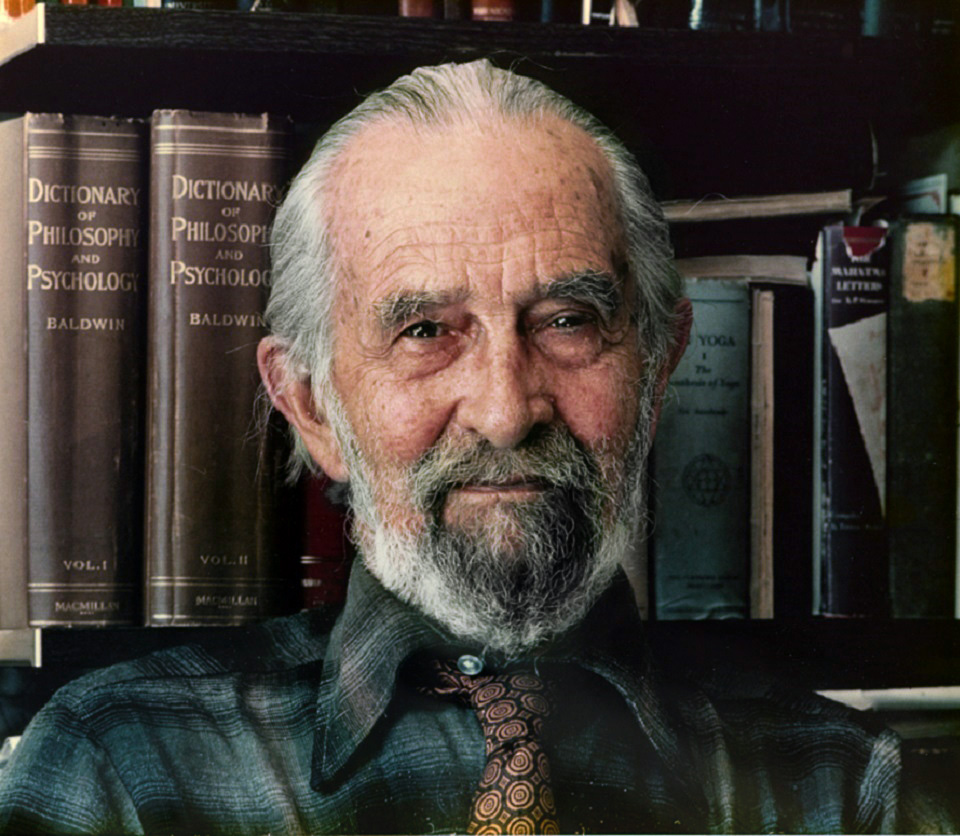
Franklin Merrell-Wolff (1887-1985) was an American intellectual, mathematician, and philosopher who made it his life’s quest to seek for a transcendental realization that his studies convinced him was a possibility. In August of 1936, his quest came to full fruition as he experienced a full Realization. His principal works – Pathways through to Space (1973) and The Philosophy of Consciousness without an Object – provided an invaluable light along the way for those who discovered his works. Pathways was a journal written in the first 100 days after his Realization, thereby providing a first-hand perspective of the process, the content of the Realizations, and its effects on the personal man. Philosophy was a further development, in axiomatic language, of a system of thought built around the fundamental core of Realization.
Merrell-Wolff owed much of his philosophical orientation to Advaita Vedanta, the works of Shankara being a primary inspiration. Buddhist thought figured prominently in his outlook; he also borrowed liberally from Theosophy. However, all of his prior influences were fused and molded into a unique and ultimately singular perspective and offering delivered with a distinctly Western mien that holds particular appeal for those inclined to Jnana yoga – the yoga of wisdom.
Merrell-Wolff isn’t accessible for everyone. His presentation is formal and can be dense and difficult to follow. His path – one centered on the life of the mind – was not the one traveled by most. But for those of similar inclination, his words pulse with radiant Truth and can open doors that were formerly closed.
Approached from the usual standpoint of relative consciousness, the ‘I’ seems to be something like a point. This ‘point’ is one man is different from the ‘I’ in another man. One ‘I’ can have interests that are incompatible the interests of another ‘I,’ and the result is conflict. Further, the purpose of life seems to center around the attainment of enjoyment by the particular I-point which a given individual seems to be. It is true that in one sense the ‘I’ is a point, and the first objective of the discriminative practice is the isolation of this point from all the material filling of relative consciousness, and then restricting self-identity to this point. For my part, I finally applied this technique with success. But, almost immediately, at the moment of success, a very significant change in the meaning of the ‘I’ began to develop. A sort of process of ‘spreading out’ began that culminated in a kind of spatial self-identity. I found that the ‘I’ had come to mean Space instead of a point. It was a Space that extended everywhere that my consciousness might happen to move. I found nowhere anything beyond Me, save that at the highest stage both ‘I’ and Divinity blended in Being. But all of this process involved both an intensifying and broadening of Consciousness, and most emphatically not a narrowing or ‘pinching out’ of it. … the Space-I is a State of infinite completeness, as compared with the consciousness of any point-I or the compound effect of any number of point-I’s. Of course, such a State is one of Bliss immeasurably transcending anything possible for any point-I. It is the Space-I Consciousness which is Nirvana.
Franklin Merrell-Wolff (1887-1985), Pathways through to Space (October 17, 1936)
LXXXII: The Point-I and the Space-I, (2nd Edition, Julian Press, NY, 1973, pp. 216-219)
Further Resources:
- The Franklin Merrell-Wolff Fellowship
- The Great Space Center
- Pathways through to Space
- The Philosophy of Consciousness without an Object
 Via Perennis