

Jungian Active Imagination
What did these people do in order to bring about the development that set them free? As far as I could see they did nothing (wu wei) but let things happen. As Master Lao-Tsu teaches in our text, the light circulates according to its own law if one does not give up one’s ordinary occupation. The art of letting things happen, action through non-action, letting go of oneself … became for me the key that opens the door to the way. We must be able to let things happen in the psyche. For us, this is an art of which most people know nothing. Consciousness is forever interfering, helping, correcting, and negating, never leaving the psychic processes to grow in peace. It would be simple enough, if only simplicity were not the most difficult of all things…
Carl Jung, Collected Works 13, Paragraph 20
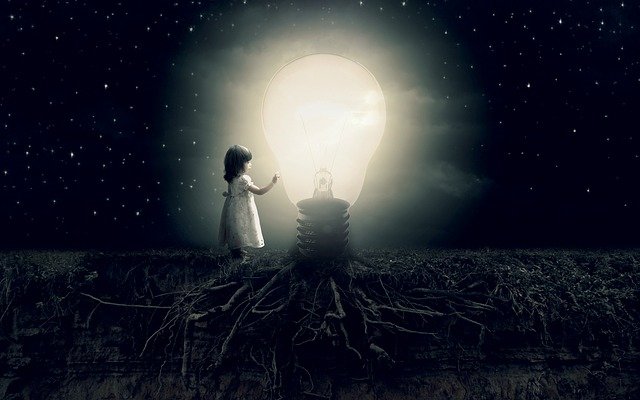
Carl Jung posited two techniques for individuals to begin to explore their unconscious realms. One we are all familiar with is dream recall and interpretation through journaling. The second, less well-known but perhaps even more powerful, is a technique called active imagination. Active imagination is a process in which the person ventures to the edge of their conscious awareness, that subliminal reverie between sleep and wakefulness, makes a call into the unconscious, and waits for figures to arise from the unconscious. These figures are then allowed to animate themselves and “speak” with the individual, thereby conveying their messages. The individual can be an active participant in this exchange and can respond and act autonomously; the difference, however, is that the ego is not controlling the entire mindscape, but acts only as an equal among equals in it.
Although, to a certain extent, he looks on from outside, impartially, he is also an acting and suffering figure in the drama of the psyche. This recognition is absolutely necessary and marks an important advance. So long as he simply looks at the pictures he is like the foolish Parsifal, who forgot to ask the vital question because he was not aware of his own participation in the action. But if you recognize your own involvement you yourself must enter into the process with your personal reactions, just as if you were one of the fantasy figures, or rather, as if the drama being enacted before your eyes were real.
Carl Jung: The Conjunction, Collected Works 14, paragraph 753.
In the latter case you choose a dream, or some other fantasy-image, and concentrate on it by simply catching hold of it and looking at it. You can also use a bad mood as a starting-point, and then try to find out what sort of fantasy-image it will produce, or what image expresses this mood. You then fix this image in the mind by concentrating your attention. Usually it will alter, as the mere fact of contemplating it animates it. The alterations must be carefully noted down all the time, for they reflect the psychic processes in the unconscious background, which appear in the form of images consisting of conscious memory material. In this way conscious and unconscious are united, just as a waterfall connects above and below.
Carl Jung: The Conjunction, Collected Works 14, paragraph 706.
Jung also suggests that the person follow up their active imagination reverie with a concrete effort to translate the previously unconscious image into some form of artistic expression, whether painting, sculpting, drawing, dance, or some other form. This integrated process gives expression to the previously mute figures of the subconscious and thus allows to some degree in the very process of engagement an alchemical synthesizing of their psychic contents with the conscious personality. The light of consciousness expands as a result.
Ignatian Imaginative Contemplation
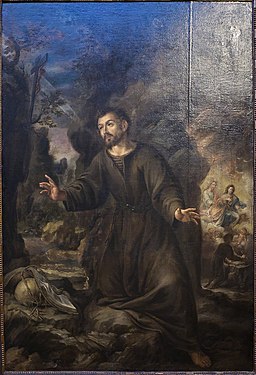
Alternatively, the individual may launch his own train of imagination while in this state, but at a certain stage, he steps back from directing the course of action and allows the imagery to take its own course (or follow a predetermined storyline) as he observes. Here, too, the person retains the ability to act as an imaginal agent, but not as the director of the drama.
The Jesuits of the Catholic Christian faith use a process very similar to this as one of their contemplation techniques. St. Ignatius of Loyola in his Spiritual Exercises (written in the 1500s) suggested using the events of Christ’s life as the seed images for an active imagination approach to prayer and contemplation. An example drawn from the second week of exercises:
THE SECOND CONTEMPLATION IS ON THE NATIVITY
The Spiritual Exercises of St. Ignatius of Loyola, Second Week, the Nativity
Prayer.
The usual Preparatory Prayer.
First Prelude. The first Prelude is the narrative and it will be here how Our Lady went forth from Nazareth, about nine months with child, as can be piously meditated, 9 seated on an ass, and accompanied by Joseph and a maid, taking an ox, to go to Bethlehem to pay the tribute which Caesar imposed on all those lands (p. 135).
Second Prelude. The second, a composition, seeing the place. It will be here to see with the sight of the imagination the road from Nazareth to Bethlehem; considering the length and the breadth, and whether such road is level or through valleys or over hills; likewise looking at the place or cave of the Nativity, 10 how large, how small, how low, how high, and how it was prepared.
Third Prelude. The third will be the same, and in the same form, as in the preceding Contemplation.
First Point. The first Point is to see the persons; that is, to see Our Lady and Joseph and the maid, and, after His Birth, the Child Jesus, I making myself a poor creature and a wretch of an unworthy slave, looking at them and serving them in their needs, with all possible respect and reverence, as if I found myself present; and then to reflect on myself in order to draw some profit.
Second Point. The second, to look, mark and contemplate what they are saying, and, reflecting on myself, to draw some profit.
Third Point. The third, to look and consider what they are doing, as going a journey and laboring, that the Lord may be born in the greatest poverty; and as a termination of so many labors — of hunger, of thirst, of heat and of cold, of injuries and affronts — that He may die on the Cross; and all this for me: then reflecting, to draw some spiritual profit.
Colloquy. I will finish with a Colloquy as in the preceding Contemplation, and with an OUR FATHER.
Certainly there are differences between this more directed and intentional use of imagination in the support of one’s religious faith, and the less structured, less directed version that Carl Jung is setting forth. Both types, though, use the mind’s imaginal capacities in the service of human spiritual and psychological growth and refinement.
Artistic Imagination
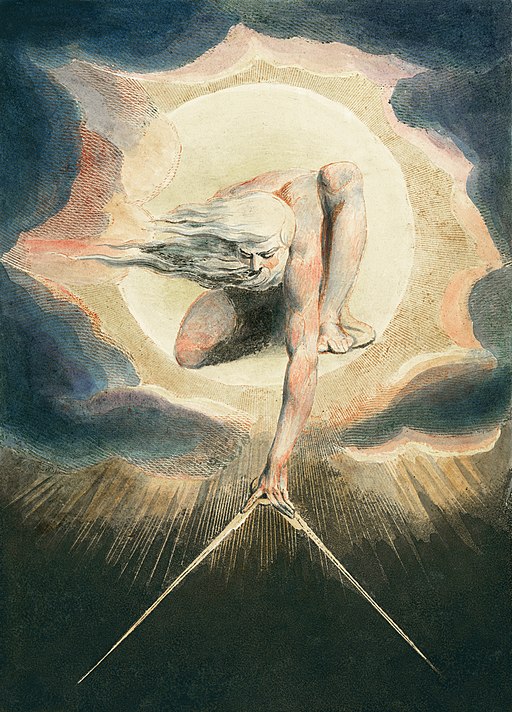
Here we also begin to touch into the realm of the artist, the poet, the creator, when specifically used for spiritual growth and development purposes. William Blake, poet, engraver, writer, and illustrator from 18th century England, built an entire way of life around pursuing and developing Imagination. It could even be said Imagination was his muse:
I know of no other Christianity and of no other Gospel than the liberty of both body & mind to exercise the Divine Art of Imagination” (Jerusalem, 77).
Writings of William Blake, 1757 -1827
The imagination is not a state: it is the human existence itself.
Imagination is the real and eternal world of which this vegetable universe is but a faint shadow.
Blake’s work was shot through with imagination bursting from every creation. His The Marriage of Heaven and Hell, Songs of Innocence, Songs of Experience, as well as his paintings and engravings testify to the vision of a man who saw the world through eyes of fire and a mind steeped in imaginal imagery and themes. Blake was a visionary who saw deeply in all respects, aided by an imagination that showed genius at every turn..
 Via Perennis