
This post arises out of an ongoing homeopathic quest for better health and vitality. Homeopathy, for readers unfamiliar with it, is a therapeutic system developed in the late 18th century based on the principle of similia similibus curentur (“like cures like”). Remedies are prepared through serial dilution and succussion, a process believed to imprint an energetic or informational signature of a substance rather than act through chemical dose. Classical homeopathy evaluates changes across physical, emotional, mental, and energetic domains, with the expectation that a well-chosen remedy will stimulate the organism’s inherent capacity for self-regulation and restoration.
The remedy discussed here is Praseodymium (Chemical symbol: Pr, Atomic weight 59), a rare-earth metal belonging to the lanthanide series of the periodic table. Within homeopathic literature, Praseodymium has classically been associated with issues of autonomy, internal sovereignty, auto-immune disorders, Parkinsonism, and skeletal issues. However, remedies from the lanthanide group have historically been underutilized, largely due to limited provings and sparse clinical documentation. Only in the past two decades—particularly following the publication of Secret Lanthanides by Jan Scholten—have lanthanides like Praseodymium begun to be prescribed with any regularity. Scholten’s work reframed these elements as remedies with profound implications for autonomy, inner structure, and the development of an independent yet integrated self, opening a clinical territory that is still very much being mapped.
I want to document an experience with this remedy that does not fit neatly into the symptom–emotion–narrative frameworks that dominate most homeopathic case histories. Because so little has been written about remedies acting at a deeply structural–energetic level, I’m offering this as a phenomenological account rather than a completed theory. What follows is not about mood lift, emotional catharsis, symptom alleviation, or symbolic imagery. It is about the revamping of somatic energetic architecture.
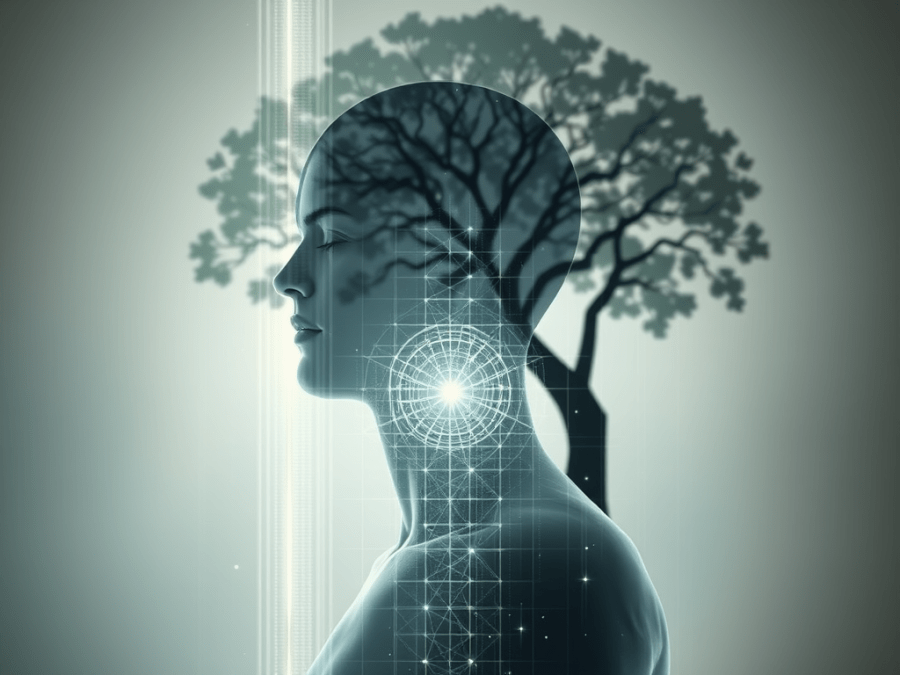
Within a short time of taking Pr., I became aware of something best described as an energetic continuum or grid manifesting in a vertical plane behind the body. This was not a localized sensation, nor a wave moving through tissues, but a coherent spatial organization—like a latent coordinate system suddenly becoming perceptible. I felt as if I was leaning back against a tree that could support my entire body weight. It didn’t feel like “energy moving,” but more like invisible and previously imperceptible structure revealing itself. The experience had a quiet inevitability to it, as if something already implicit was being switched on rather than introduced.
The most striking feature was the way this energetic grid migrated slowly forward into the body over a period of several weeks, incorporating the spine and the entire dorsal side of the body, from the crown of the head to the heels. The spine did not feel activated or stimulated; instead, it felt inhabited. The vertical axis of the body became the organizing principle around which everything else quietly rearranged. Eventually, there was a palpable sense of the spine acting as a central plumb line—an axis of reference rather than an effortful support, with a subtle sense that this vertical axis extended beyond the head above and beyond the feet below. This was accompanied by a subtle but unmistakable sense of vertical integrity, as though the body now knew somatically what “upright” truly was.
A chronic forward energetic lean in my makeup—so familiar I had long ceased to notice it—released gradually and without conscious correction. How might this be understood? Most of us, in the ordinary conduct of life, are perpetually “leaning forward” into existence: projecting effort, exerting will, initiating action, and pushing toward outcomes. This posture of intention becomes so habitual that it disappears from awareness, yet it quietly shapes both our energetic orientation and our physical carriage.
When that forward lean began to unwind in my case—not abruptly, but through a slow and steady recalibration—it produced a mild but unmistakable disorientation, both energetically and somatically. In the body, there was a faint sense of being slightly off-balance, akin to walking on a ship moving through gentle seas. Energetically, it felt as though a familiar motivational drive had drained away, along with the propulsion that had accompanied it. Through reflection and journaling, it became clear that this forward lean had been masquerading as vitality. In reality, it was a momentum long borrowed against my somatic reserves, sustained for decades through compensatory effort rather than intrinsic support.
A physical analogy may clarify this: anyone who has labored up a mountain pass carrying a forty- or sixty-pound pack knows the posture required to do so. One leans forward, engages will, and pushes through. But upon reaching the pass, the pack comes off. One stops, stands upright, and looks around again—often with a surprising sense of fatigue only then becoming apparent. The action of the remedy felt remarkably similar. It was as though it quietly said, “That’s enough. Let’s set the load down and allow you to reorient and recover.” And indeed, the prior cost of that long-standing lean is now making itself known; fatigue and depletion have become noticeable in its absence.
Importantly, these changes did not feel muscular, corrective, or imposed. Equally notable was what did not occur. There was no emotional surge, no resurfacing of memories, no alteration of mood, and no significant change in conventional symptoms. This absence is worth emphasizing, as it suggests that the remedy’s primary action—at least in this case—was not operating on emotional, psychological, or narrative strata at all. The shift was ontological rather than psychological: a change in how the system is organized in space and relation, rather than how it feels or what it expresses. But there were regular progress reports of the reconstruction project offered by dreams.
The earliest dreams were dominated by themes of quantity, excess, and persistent effort—pus being expressed far beyond expectation, mucus flowing endlessly despite repeated attempts at management, a golden thread unraveling to absurd lengths, and bungy cords being extended to near-impossible distances. In each case, the dream highlighted that more effort, more extension, more output did not achieve sufficiency. Labor, persistence, or endurance alone could not resolve the underlying structural condition. The images were explicit: pushing, stretching, and managing continued production, yet nothing reached completeness or resolution.
Following this phase of discharge, subsequent dreams began to show a shift toward vertical orientation, efficiency, and integration. The imagery moved from struggling with unending output to scenes of uprightness and controlled motion: inch-worming through corridors only to be lifted into upright posture, walking long distances under one’s own power despite available vehicles, and riding a bicycle with effortless balance and forward velocity. These dreams emphasized that stability, alignment, and vertical coherence were prerequisites for effective motion and function. Forward movement became natural only once the structural axis—spinal and postural—was correctly inhabited, reflecting a transition from compensatory effort to inherent organizational capacity.
Across this sequence, the dreams charted a consistent trajectory: first, the disclosure of excess and the impossibility of sufficiency through effort alone; then, the emergence of structural insight and autonomous organization. They did not deal with emotional catharsis or narrative content. Rather, they appeared to report on energetic and structural recalibration, showing the gradual release of habitual forward lean, the emergence of vertical integrity, and the conditions under which the system could operate efficiently without borrowed momentum.
The experience of the vertical plumb line was not an abstract idea or a visual image, but a lived spatial fact. Standing and walking felt different not because something was being done better, but because deviation from verticality no longer seemed necessary. There was a quiet dignity to this—an unforced alignment that felt deeply autonomous.
Perhaps the most profound implication of this experience lies in what I can only call ontological restructuring. The sense of self-in-body subtly shifted from one of continuous micro-adjustment to one of inherent organization. Autonomy, in this context, did not mean independence or effortful control. It meant that the system appeared capable of organizing, orienting, and maintaining itself without constant compensatory strategies. The body was no longer negotiating with gravity or space—it was participating in them.
If remedies like Pr. can act at this level—engaging spatial coherence, axial organization, and structural truth rather than symptom expression—then our case-taking frameworks may be missing an entire domain of action. Are there remedies whose primary sphere is structural–ontological rather than emotional or functional? How often do we overlook such effects because we are listening for stories and looking for emotional grand reveals instead of sensing subterranean architecture? What would it mean to follow a case where “nothing happens,” yet everything quietly realigns?
I offer this account not as a conclusion, but as an invitation. If others have experienced similar non-dramatic yet foundational shifts, it may be time to begin articulating a language—and a clinical sensitivity—equal to them.
 Via Perennis