

A long, long time ago, I can still remember…
Fall of 1979, my short stint at the U.S. Naval Academy. A time of upheaval, constant stress, fear and loathing. There wasn’t a whole lot of positive I personally took away from there when I left mid-year, but two indelible memories stick with me. One is a vision, the other a soundtrack.
The Navy Chapel on campus was a sacred refuge from the stresses of plebe summer and the fall academic semester. I was fortunate to have a good enough voice to be accepted as a member of the USNA Protestant Chapel Choir. I say fortunate because it gave me a recurring reason to escape the daily maelstrom for an hour or so and spend time in the interior of this beautiful chapel. It gave off numinous vibes at all times, with hushed interiors, unusual blue carpet, beautiful white marble, and stained-glass windows incorporating naval themes with Christian iconography. It was so important to me personally that to this day, I keep a picture on the wall of my office reminding me daily of that sacred space.
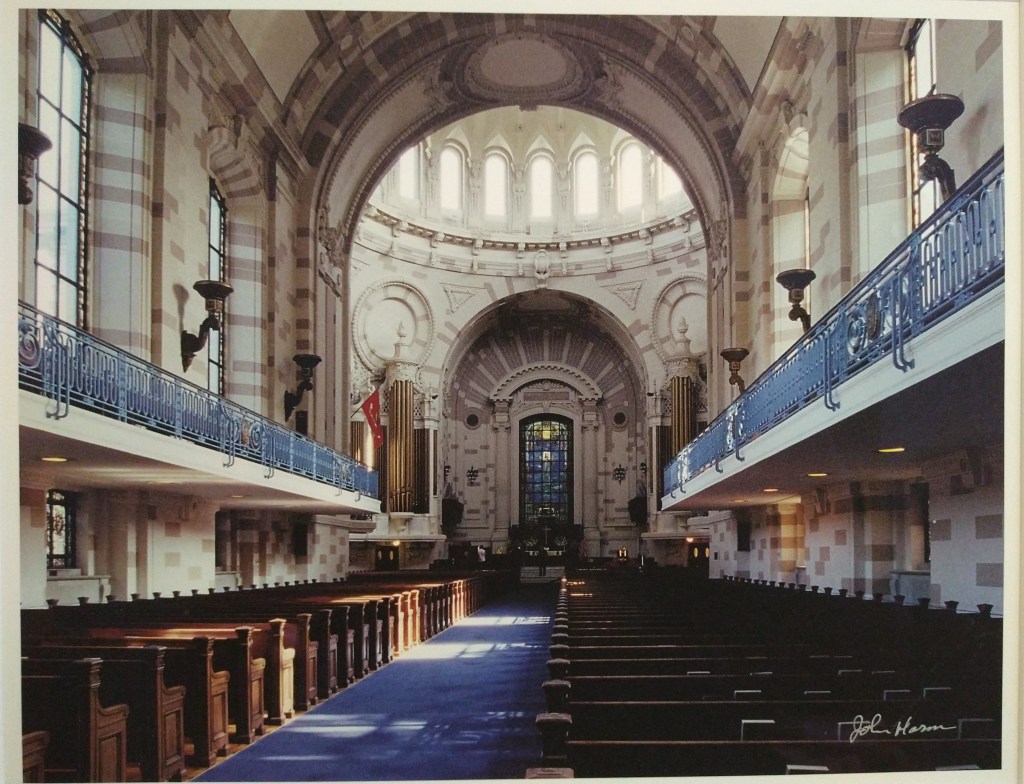
The second memory is a hymn that came to epitomize the essence of the sound of transcendental beauty to me. I am speaking of the Navy Hymn.
The Navy Hymn, also known as “Eternal Father, Strong to Save,” holds significant historical and emotional value for the United States Navy. Written by English clergyman William Whiting in 1860, the hymn’s lyrics were inspired by Psalm 107 and reflect the prayers for protection and guidance of sailors at sea.
The hymn gained prominence during the American Civil War when it was sung by both Union and Confederate naval forces. Its powerful words and haunting melody resonated with sailors, providing comfort and solace during perilous times. The hymn’s popularity continued to grow, and it became officially adopted by the U.S. Navy in 1879.
Its significance extends beyond the United States, as the Navy Hymn has also been embraced by naval forces around the world. It is often performed during military ceremonies, such as ship christenings, funerals, and memorial services, serving as a symbol of unity, honor, and devotion to duty.
To this day, the Navy Hymn remains a cherished piece of music that embodies the dedication, bravery, and faith of those who serve in the Navy. Its profound impact on sailors, past and present, is a testament to the enduring power of music to inspire and uplift the human spirit.
Its haunting yet curiously serene and comforting melody recurs to me occasionally, reminding me of the beauty even in peril and danger, and more – yes, even in tragedy and grief. It brings up no perspective as clearly for me as one of equal parts deep compassion and equanimity. At those times, I am once again compelled to listen to it, to remind myself of the Divine as a place of refuge in tempests. It sank deep into my soul as we learned to sing it in 1979, and there it resonates with me still. I cannot hear it even now, 44 years later without it bringing tears to my eyes and a lump to my throat. It has come to signify transcendental beauty in music to me, and it always will carry that association.
If you have not heard it, do yourself a favor. Take a couple of minutes to listen to it now.
The Navy Hymn, or “Eternal Father, strong to save”
Eternal Father, strong to save,
Whose arm hath bound the restless wave,
Who bidd’st the mighty ocean deep
Its own appointed limits keep;
O hear us when we cry to Thee
For those in peril on the sea.
Eternal Father, grant, we pray,
To all Marines, both night and day,
The courage, honor, strength, and skill
Their land to serve, thy law fulfill;
Be thou the shield forevermore
From every peril to the Corps.
Amen
 Via Perennis